Contents
मङ्गलाचरणम्
Invocation and Introduction
Preface
Reason for the Choice of these portions
About the contents of Kāṭhaka portion of Taittirīya śākhā
Purport of Kāṭhaka praśna-s
General information
Some details of the Sāvitra-vedi-nirmāṇa [building of the 'vedi']
Contents of each anuvāka in the Kāṭhaka first praśna - The Savitra-Cayana.
3.10.1 - The 185 yajus which the Adhvaryu recites when he places the 185 bricks of the vedi, and the eight yajus which he recites when he puts sand on one of the lines of the ground for the vedi.
3.10.2 - The four yajus which the Adhvaryu recites when he places the four svayam-ātṛṇṇā [naturally perforated] bricks.
3.10.3 - The yajus which the Adhvaryu recites when he worships the vedi.
3.10.4 - The yajus which the yajamāna recites when he worships the vedi.
3.10.5 - The yajus which the Hotā recites for the vedi that has been completely built.
3.10.6 - The yajus which the yajamāna recites when he does añjana [anointing] to his face with ghee.
3.10.7 - The twenty-one yajus which the Adhvaryu recites when he makes twenty-one havis-offerings after the añjana (anointment) of the yajamāna.
3.10.8 - The yajus which the Adhvaryu recites when, at the paśu [animal] yajña, he draws for Mṛtyu (Deity of Death) a graha [draught of broth] from the paśu, and sits it down on the uttara-vedi. The two mantra-s which he recites when he pours the āhuti into the agni. The yajus which the yajamāna or the Adhvaryu recites when he drinks the rest of that draught. The yajus by which the yajamāna firmly establishes the prāṇa [vital breath] in himself.
3.10.9 - Metaphoric explanations of some of the yajus used for the building of the Sāvitra vedi, and reflections concerning the Sāvitra vedi in general. Dialogue between a brahmacāri [student of Atyaṁha Āruṇi, son of Aruṇa], and Plakṣa Daiyāmpāti. Illustrations of - 1 Janaka Vaideha, 2 Ahīnā Āśvatthya, 3 Devabhāga Śrautarṣa, and 4 Śūṣa Vārṣṇeya's experiences regarding the Sāvitra vidyā.
3.10.10 - Metaphoric explanations pertaining to the yajus of anuvāka-1.
3.10.11 - Metaphorical explanations concerning the Sāvitra agni and the Sāvitra vedi. Episode of Bharadvāja on infinity of Vedas. The reason behind the Sāvitra vedi being called so.
The Naciketa-cayana.
The Naciketa-cayana.
3.11.1 - The twenty-one formulas which the Adhvaryu recites when he places the twenty-one bricks of the fire-altar.
3.11.2 - The formulas which the Adhvaryu recites for the Śatarudrīya-oblation.
3.11.3 - The formulas recited by the Adhvaryu for the oblation which is called "Stream of wealth".
3.11.4 - The formulas recited by the Adhvaryu for the oblation which is called "Food-oblation"
3.11.5 - The formulas recited by the Adhvaryu for the Viśvaprī-oblations
3.11.6 - The formulas which the Adhvaryu, acting for the Sacrificer, recites when he touches the fire-altar. The two formulas which he recites when he deposits the space-filler bricks. The five formulas which he recites when he touches the fire-altar. The formula which he recites when he spreads loose earth on the layer of bricks.
3.11.7 - Symbolical interpretations and theological explanations of the Nāciketa fire-altar.
3.11.8 - Story of Naciketas. Theological explanation of the reason why gold is the dearest of all valued objects, and theological explanation of the word dakṣiṇā.
3.11.9 - The Naciketa fire-altar should be built on the occasion of a Soma-sacrifice. Special rites that should be performed if the Sacrificer wishes to be endowed with fiery energy, glory, and preeminence in sacred lore. The four libations that should be performed at the end of the ceremony
3.11.10 - Rewards obtained by the Sacrificer who builds the Nāciketa fire-altar. The Naciketa fire-altar is identified with the year.
आविष्णोरभिवन्द्यादावाचार्याणां परम्पराम् । वेदाचार्यांश्च मे तातान् पराङ्कुशसदाह्वयान् ॥
वात्स्यरामानुजार्येण तैत्तिरीयमधीयता । काठकाच्छिद्रभागस्य साश्वमेधस्य सम्प्रति ॥
अनुवादो नवीनानां याच्ञयाऽऽङ्ग्लगिरा परम् । विधीयते विविदिषाजननाय पुरातने ॥
वेदवाङ्मयनिक्षिप्तसुरत्नान्वेषणे सताम् । सुरभाषां द्रामिडीं वाऽजानतां श्रद्धयायुते ॥
भक्तिज्ञानाभिवृद्ध्यै च क्रमशो मूलभाषया । ज्ञातृसौकर्यसिद्ध्यै वा क्षन्तव्यो भूसुरैरहम् ॥
After prostrating with utmost devotion to the long uninterrupted lineage of great preceptors starting from Bhagavān ŚrīmanNārāyaṇa and my renowned father and Vedic preceptor, Śrī Parāṅkuśācārya Svāmī, I, Śrīvatsa Rāmānujācārya, now intend to translate in English, the portions named Kāṭhaka, Acchidra and Aśvamedha, and mantras used in Sandhyāvandanam, in Taittirīya branch of Kṛṣṇa Yajurveda. This is to fulfil the request of those wishing to unearth, with deep faith and reverence, the treasures hidden in Vedic scriptures, but lacking the ability to follow Saṁskṛtam or Tamizh languages, so that they are enabled to grow their knowledge and devotion, eventually becoming capable of following the original texts themselves. I may be pardoned by traditional scholars for this transgression.
Go Top
True imports of Vedic texts are not easy to comprehend, without the help from Vedāṅga-s [six auxiliary śāstra-s [disciplines] of: 1. Śikṣā [science of Phonetics], 2. Chandas [Science of Metrics/Prosody], - these two for proper pronunciation of akṣara-s, i.e, alphabets; 3. Vyākaraṇam - Science of Grammar, 4. Niruktam [Science of Etymology] - these two for arriving at proper meanings; 5. Jyautiṣam [Science of Astronomy] and 6. Kalpaḥ [Science of applicatory procedures] - these two for attaining desired fruit by the performance of yajña-s etc, prescribed], in their entirety. So, while commenting on the meanings of Veda-s, earlier authors like Bhagavad Bhāṣyakāra, SudarśanaSūri, Śrīmad VedāntaDeśika, Bhaṭṭa-bhāskaraMiśra, Sāyaṇācarya, UpaniṣadBhāṣyakāra ŚrīRaṅgaRāmānujāMuni, etc. [in Tamil and Kannada also some scholars have translated some of these works] have taken recourse to these also to explain the details. Consulting earlier works beneficially as suitable, I would briefly cover some of these, where needed, to help better understanding of the meanings.
Go Top
covering these six praśna-s (Kāṭhaka, Acchidra and Aśvamedha) and Sandhyāvandana mantra-s}, is based on their significance and frequency of usage, and hence, help in better reciting these mantras, if done with knowledge of their meanings, being effective and efficacious.
Beginning with Upanayanam, a Śrīvaiṣṇava has to perform trikāla-sandhyā-vandanam daily till he is alive. Hence, the benefit of knowing their meanings is obvious, due to sheer frequency of their usage. On Ekādaśī days, Acchidra and Aśvamedha praśna pārāyaṇam and on Dvādaśī days, Kāṭhaka praśnas' pārāyaṇam has been traditionally being done by śiṣṭa-s, due to their nature of removing pratibandhaka karma [obstacles to prosperity] to attaining bhagavad bhakti and kaiṅkaryam, due to these praśna-s embodying the mantra-s suitable for pāpaśamanam [prāyaścitta mantra-s in Darśapūrṇamāśa, agnihotra, etc. in Acchidra praśna and sarva-pāpa-prāyaścitta including brahma-hatyā in Aśvamedha praśna-s are significant and with upavāsa on Ekādaśī days, their recitation burns all sins [aniṣṭa-nivṛtti]. Kāṭhaka praśna-s deal with tattva, hita and puruṣārtha in very deep and subtle way and their recitation on dvādaśī after ekādaśī upavāsa aids iṣṭa-prāpti.
Go Top
Vedas basically describe Yajña, {derived from the verbal root 'yaj', meaning deity worship, connecting, offering} i.e, worship of Bhagavān, through reverential offerings made to deities as prescribed, for obtaining desired fruit. Even the entire life and its activities are taught as a yajña, being in tune with nature [inanimate matter] and living beings [Jīvātmā-s], since both are the organic part of the Īśvara, paramātmā [the three real entities]. The Agni [sacred fire] used for offering havis (prescribed object) for the pleasure of deities - is sanctified and maintained lifelong. While starting the agni-s is called 'agni-Ādhāna', creating the 'Vedi' [yajña's platform/vedi] using bricks is called 'Cayanam'.
There are big and small scale of 'cayanam', in various outline forms, prescribed for various yajña-s in Taittirīya Saṁhitā and Brāhmaṇa portions and this part is from the Kaṭha śākhā of Kṛṣṇa Yajurveda, studied with Taittirīya śākhā [but retaining the name Kāṭhaka, i.e, derived from Kaṭha śākhā].
Go Top
There are three praśna-s, [chapters] dealing with Tattva, Hita and Puruṣārtha [Reality, means of achieving fruit and desirable fruit, respectively]. This is taught metaphorically through universal concepts like, the Sun orb, in the form of Time-reckoner, encompassing all the three real entities, in the first called Sāvitra Cayanam; in the second, as the means through the Episode of Naciketas, an ideal disciple to receive highest knowledge, in Nācikata Cayanam and in the final praśna, reaching the eternal place of Vaikuṇṭha, after release from bondage for all bound living beings by the meditation of the Supreme entity, and performing eternal service to Him, as the ultimate puruṣārtha, through Cāturhotra and Vaiśvasṛja cayanam-s. The last cayanam involves esoteric concepts, envisaged as bricks in a physical yajña.
The concept of physical yajña also is needed, to understand clearly, the way the teachings are found in these praśna-s. A brief outline of such detail also is presented where appropriate, for the sake of completion and better comprehension of the principles contained herein.
Vedārtha Saṅgraha of Bhagavad Rāmānujācārya, clearly shows the entire Vedic texts are in unison teaching us about the three tattva-s, in suitable manners and layers, being complimentary to philosophical teachings in harmony. At different stages and stations in life, living beings evolve gradually to be eligible for and receive divine grace and blessing, culminating in eternal release from bondage [samsāra].
We would be using the technical terms like, agni, iṣṭakā, cayana, iṣṭi, puroḍāśa, tattva, hita, puruṣārtha, Jīvātmā, Paramātmā, Īśvara, etc., without translating, but will be providing a glossary with necessary descriptions and explanations.
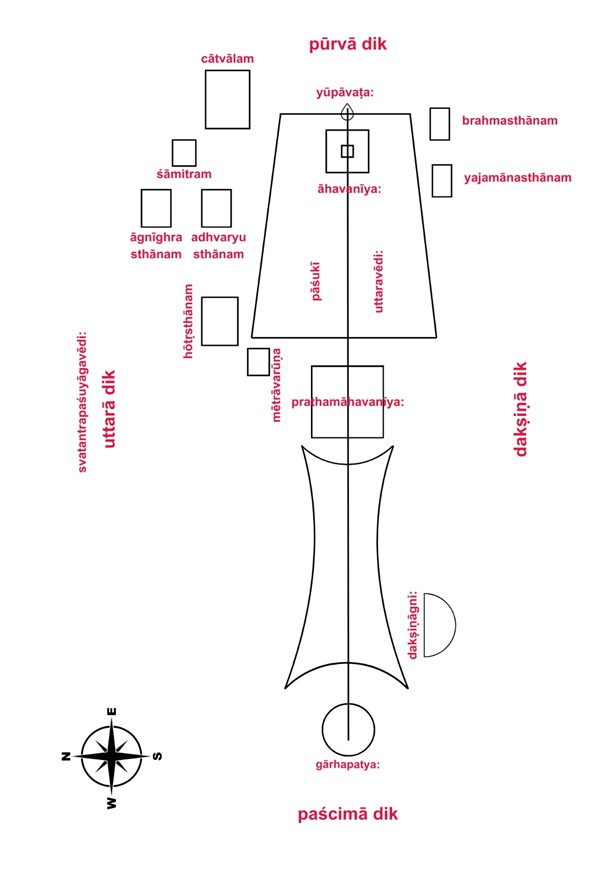
Three agni-s are used in yajña-s called Āhavanīya, Gārhapatya and Dakṣiṇa. In yajña-s like Somayāga, a place to the east of Āhavanīya is designated as 'uttara-vedi' and agni of Āhavanīya is taken there and homa-s [pouring ghee etc. in the agni] are ordained. Iṣṭaka refers to bricks used in specified forms, number and method [indicated in Śrautasūtra-s]. Such arrangement of bricks to place the agni with mantra-s as 'vedi' is called 'cayanam', and vedi is referred to as [a form of] agni itself. By yajña-s, skies are nourished by agni-s while clouds nourish earth.
Go Top
In the first praśna here, Sāvitra Cayana is described, having Savitṛ [Sun] as the main deity.
Those desirous of attaining 'svarga' the world of bliss, [defined as that which is not mixed with sorrow, not leading to it even later, and achieved by desiring it (by prescribed means)] are eligible to perform this sāvitra cayanam (i.e., the building of the 'vedi' in the form of the Sun).
The Ṛṣi [one who saw these mantra-s first] for these praśna-s is 'Agni Havyavāṭ' [one who carries offerings given for deities called 'havya'].
Go Top
Go Top
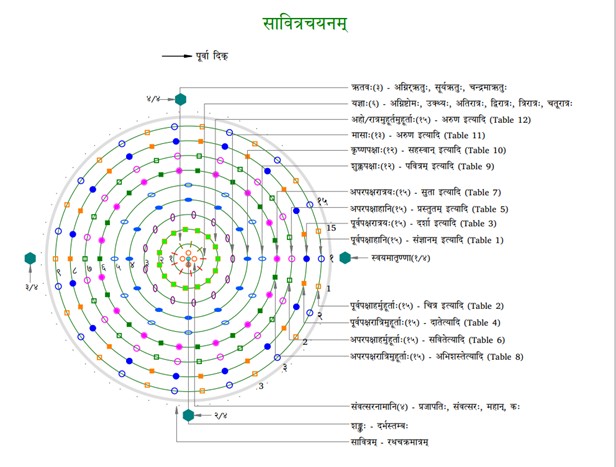
Time-units like muhūrta-muhūrta [3.2 minutes], muhurta [48 minutes duration], day, night, fortnight, month, season and year etc. reckoned due to the traversal of Sun are represented by small bricks/stones [golden pieces or pebbles the size of the top [one-third] section of a finger, smeared with ghee - in all 185 in number]. They are arranged as per Śrautasūtra prescriptions in nine concentric circular spaces, and in the hub portion, Āhavanīya agni is kept. This verily may be called kāla-cakra [wheel of time]. A Diagram depicting this is included here.
Combined Image
Meaning
The break-up of 185 are the names of:
In 9th (outermost) concentric circle,
i) 15 days of śukla fortnights and 15 muhūrta-s each of the days of śukla fortnights = 30
In 8th (second from outermost) concentric circle,
ii) 15 nights of śukla fortnights and 15 muhūrta-s each of the nights of śukla fortnights = 30
In 7th (third from outermost) concentric circle,
iii) 15 days of kṛṣṇa fortnights and 15 muhūrta-s each of the days of kṛṣṇa fortnights = 30
In 6th (fourth from outermost) concentric circle,
iv) 15 nights of kṛṣṇa fortnights and 15 muhūrta-s each of the nights of kṛṣṇa fortnights = 30
In the fifth concentric circle,
v) śukla fortnights of the year - 12
In the sixth concentric circle from outside,
vi) kṛṣṇa fortnights of the year - 12
In the seventh concentric circle from outside,
vii) months of the year [including one extra month called Adhimāsa, in some years] - 13
In the eighth concentric circle from outside,
viii) muhūrta-s of muhūrta-s [3.2 minutes duration, i.e, 15th part of a muhūrta of 48 minutes] of any day or night = 15
In the first [innermost] concentric circle,
ix) six yajña-kratu and 3 ṛtu-s = 9
In the nābhi (hub) = 4
adding up to 185.
All stones/bricks are placed starting from the eastern direction in the respective circular paths.
Outside the circles [one in each direction] = 4.
Time units are reckoned by the movements of celestial objects which profoundly impact living beings on earth continuously. The primordial matter Prakṛti, is comprised of three qualities/attributes of sattva [leading to right knowledge, pleasure etc.], rajas [leading to action, wrong comprehension and arrogance] and tamas [leading to inertness, non-comprehension, sleep etc.], whose composition keeps changing every moment, eternally and hence feelings of beings keep changing continually. The properties of different, though contiguous, time-units depict various combinations of the fundamental [three] attributes, and the names are derived from their instantaneous values. The whole cycle repeats in a frame of a year and so till a year they are considered and figuratively mentioned as time suitable for certain kinds of events/actions etc.
The denotational meanings of these names [corresponding to the respective time-units] are as under:
Explanations are given according to BhaṭṭaBhāskaraBhāṣya, wherein he relates the properties to the increasing and decreasing brightness and a general classification of each of the fifteen 'tithi'-s into five descriptions as Nandā, Bhadrā, Jayā, Riktā and Pūrṇā [repeating thrice in each fortnight, i.e, 1st, 6th, 11th; 2nd, 7th, 12th etc.] found in Vedic kalpa explanatory texts.
Mere literary translation of the names may not be suitable as the astronomical context may then be missed.
Genders of the names also reveal the time-unit classes. e.g., 'Ahas' = day, is Neuter gender and hence day names are in neutral gender. 'Rātriḥ' = night, is feminine and 'muhūrta' = 48-minute duration, 'māsa' = month, ardhamāsa = fortnights, 'ṛtu' = season, 'samvatsara' = year, are masculine, and hence, names associated to these have similar genders.
saṃjñānaṁvvijñānaṃ prajñānañjānadabhijānat . saṅkalpamānaṃ prakalpamānamupakalpamānamupaklṛptaṅklṛptam . śreyo vasīya āyathsambhūtambhūtam . citra ketu prabhānābhānthsambhān . jyotiṣmāstejasvānātapa stapannabhitapann . rocano rocamānaśśobhanaśśobhamāna kalyāṇaḥ . darśā dṛṣṭā darśatā viśvarūpā sudarśanā . āpyāyamānāpyāyamānāpyāyā sūnṛterā . āpūryamāṇā pūryamāṇā pūrayantī pūrṇā paurṇamāsī . dātā pradātāऽऽnando moda pramodaḥ (1)
āveśayanniveśayanthsaṁvveśanassaśāntaśśāntaḥ . ābhavanprabhavanthsambhavanthsambhūto bhūtaḥ . prastutaṃ viṣṭuta sastutaṅkalyāṇaṁvviśvarūpam . śukramamṛtantejasvi tejassamiddham . aruṇambhānumanmarīcimadabhitapattapasvat . savitā prasavitā dīpto dīpayandīpyamānaḥ . jvalañjvalitā tapanvitapanthsantapann . rocano rocamānaśśumbhūśśumbhamāno vāmaḥ . sutā sunvatī prasutā sūyamānāऽbhiṣūyamāṇā . pītī prapā saṃpā tṛptistarpayantī (2)
kāntā kāmyā kāmajātāऽऽyuṣmatī kāmadughā . abhiśāstānumantāऽऽnando moda pramodaḥ . āsādayanniṣādayanthsasādanassasannassannaḥ . ābhūrvibhū prabhūśśambhūrbhuvaḥ . pavitraṃ pavayiṣyanpūto medhyaḥ . yaśo yaśasvānāyuramṛtaḥ . jīvo jīviṣyanthsvargo lokaḥ . sahasvānthsahīyānojasvānthsahamānaḥ . jayannabhijayanthsudraviṇo draviṇodāḥ . ārdrapavitro harikeśo moda pramodaḥ (3)
aruṇoऽruṇarajā puṇḍarīko viśvajidabhijit . ārdra pinvamānoऽnnavānrasavānirāvān . sarvauṣadhassambharo mahasvān . ejatkā jovatkāḥ . khṣullakāśśipiviṣṭakāḥ . sarisrarāssuśeravaḥ . ajirāso gamiṣṇavaḥ . idānīntadānīmetarhi khṣipramajiram . āśurnimeṣa phaṇo dravannatidravann . tvarastvaramāṇa āśurāśīyāñjavaḥ . agniṣṭoma ukthyoऽtirātro dvirātrastrirātraścatūrātraḥ . agnirṛtussūrya ṛtuścandramā ṛtuḥ . prajāpatissaṁvvathsaro mahānkaḥ (4)
For the first table of fifteen names of the days of bright fortnight -
Saṁjñānam - First day - known as/to be connected [with acts of amāvāsyā like iṣṭi etc].
Vijñānam - Second day - since known distinctly [as dark fortnight activities are seldom done in this].
Prajñānam - Third day - auspicious activities are well-known in this.
Jānat - Fourth day - knows self as to be bright fortnight, but does not promote auspicious activities being the chidra [hole/gap] of the fortnight and riktā = emptying.
Abhijānat - Fifth day - knows auspicious activities by looking towards/proactively.
Saṁkalpamānam - Sixth day - being bright fortnight, auspicious activities may happen themselves, but are planned, not performed, being the chidra [hole/gap].
Prakalpamānam - Seventh day - brings about activities properly/well, happens to be the cause.
Upakalpamānam - Eighth day - assists little in acts like aṣṭakā etc., but does not fully enable, being chidra [hole/gap]
Upakl̥ptam - Ninth day - since following eighth, assists near self, but does not fit for all activities, being chidra [hole/gap] and rikāa, i.e, emptying
Kl̥ptam - Tenth day - permitted in all aspects for auspicious activities
Śreyaḥ - Eleventh day - more commendable for actitvities than even the tenth, due to the growth of Moon's phase
Vasīyaḥ - Twelfth day - more highly prosperous in goings on etc. - due to granting riches higher than the eleventh, is more laudable.
Āyat - Thirteenth day - impels/catalyses activities causatively, or comes in
Sambhūtam - Fourteenth day - as both auspicious and inauspicious get connected in it or contagious to Pourṇamī but being termed 'parva' as in previous/prior parva
Bhūtam - Fifteenth day - Candra (Moon) is not subdued in it, being facilitator of all activities.
Similarly, for the remaining tables are continued further:
For the second table, {muhūrta-s [48 minutes] of all the days of the bright fortnights}
Citraḥ - First muhūrta - fit to be chosen/collected - being the time for japa, homa etc. [Abhigamana-kāla]
Ketuḥ - Second muhūrta - reminding the time for duties to be performed - being denoter of the time also
Prabhān - Third muhūrta - due to the redness of sunrise receding, starts glowing blazingly
Ābhān - Fourth muhūrta - due the little heat or glowing allround
Sambhān - Fifth muhūrta - having a combined glow
Jyotiṣmān - Sixth muhūrta - having a great glow
Tejasvān - Seventh muhūrta - very intense glow
Ātapan - Eighth muhūrta - heat that burns allround
Tapan - Ninth muhūrta - one that uniformly burns
Abhitapan - Tenth muhūrta - burns facing towards or over earlier heat, scorching
Rocanaḥ - Eleventh muhūrta - makes beings feel good, pleasant to world
Rocamānaḥ - Twelfth muhūrta - Glowing, comfortable to all, with just required heat.
Śobhanaḥ - Thirteenth muhūrta - beautifies the world, being pleasant to all
Śobhamānaḥ - Fourteenth muhūrta - being beautiful due to revoked heat
Kalyāṇaḥ - Fifteenth muhūrta - being the time for enjoying good (sandal paste) odour, flowers etc.
For the third table, {names of the nights of all the bright fortnights}
Darśā - First night - During Amāvasyā, Candra (Moon) is darśa = unseen only
Dṛṣṭā - Second night - since Candra (Moon) is seen
Darśatā - Third night - Candra visible for a longer duration; In the second night, though Candra is seen, it is for a fleeting moment only
Viśvarūpa - Fourth night - cause of all object forms to be discerned
Sudarśanā - Fifth night - cause of clear distinction [of object forms]
Āpyāyamānā - Sixth and Seventh nights - (according to some) allround growing (light) orb/sphere in sixth
Pyāyamānā - Seventh night - allround increasing glow)
Pyāyā - Eighth night - due to abundance of edible plants etc
Sūnṛtā - Ninth night - makes world happy due to proximate positioning
Irā - Tenth night - praiseworthy due to great lustre
Āpūryamāṇā - Eleventh and Twelfth nights - eleventh becomes as though is overflowing the sphere due to great lustre
Pūryamāṇā - Twelfth night - though the sphere is incomplete, due to great lustre, seems like filling circle
Pūrayantī - Thirteenth night - fills the entire universe with brightness
Pūrṇā - Fourteenth night - similar to fifteenth night, with the deficiency being not discernible
Pourṇamāsī - Fifteenth night - Ma = Candra (Moon) is pūrṇa = full/complete and night related to him. With Moon full in all respects.
For the fourth table, {muhūrta of the nights of Bright Fortnights}
Dātā - First muhūrta - Modest Beginner of nocturnal activities
Pradātā - Second muhūrta - grand beginner/encourager of nocturnal activities
Ānandaḥ - Third muhūrta - Time for enjoyment of flowers, cosmetics etc.
Modaḥ - Fourth muhūrta - Revelling with friends etc.
Pramodaḥ - Fifth muhūrta - Enjoying heartily with women.
Āveśayan - Sixth muhūrta - Creates curiosity in bedroom etc.
Niveśayan - Seventh muhūrta - brings man and woman closely.
Saṁveśanaḥ - Eighth muhūrta - makes all beings lie down on beds.
Saṁśāntaḥ - Ninth muhūrta - calms senses connected to mind; senses are placed in mind, i.e, induces sleep.
Śāntaḥ - Tenth muhūrta - Being completely at rest, mind also resting, causes suṣupti = deep sleep.
Ābhavan - Eleventh muhūrta - enjoys satisfaction of senses allround.
Prabhavan - Twelfth muhūrta - In control, as all senses are rendered subservient.
Sambhavan - Thirteenth muhūrta - causes reconnection with senses, initiates waking.
Sambhūtaḥ - Fourteenth muhūrta - causes realisation of senses - awakens.
Bhūtaḥ - Fifteenth muhūrta - By self-realisation, has become fully awake - self-aware.
For the fifth table, {days of the dark fortnights}
Prastutam - First day - 'Sāman' being kṛṣṇa = black/dark, with five ‘bhakti-s’ = parts, the aspects of dark fortnights are likened to them. Thus, first day is likened to the first, i.e, 'prastāva', introductory part of Sāman.
Viṣṭutam - Second day - likened to the second part 'viṣṭuti'.
Saṁstutam - Third day - likened to the third part 'saṁstāva'.
Kalyāṇam - Fourth day - likened to the fourth part 'udgāna'.
Viśvarūpam - Fifth day - likened to the last part 'nidhana'.
Śukram - Sixth day - being cause of demons etc.; also due to being 'nandā' tithi.
Amṛtam - Seventh day - being cause of deathlessness of demons etc.; also due to being 'bhadrā' tithi.
Tejasvi - Eighth day - being cause of the growth of valour of demons etc.; also due to being 'jayā' tithi.
Tejas - Ninth day - being cause of encouragement of demons etc.; The doctrine of Agnividyā destroys all deeds being done; hence 'riktā' [emptying] tithi.
Samiddham - Tenth day - being replete with hostile creatures etc.; Hence 'pūrṇā' tithi.
Aruṇam - Eleventh day - cause of joy like dawn time, for tāmasic [inert] creatures.
Bhānumat - Twelfth day - A time like that of rising of Sun's orb, for demons etc.
Marīcimat - Thirteenth day - like the time when Sun's rays spread, for them - demons etc.
Abhitapat - Fourteenth day - like all-round blazing time for demons etc.
Tapasvat - Fifteenth day - like scorching sun's mid-noon time; or all demons etc. become still, like in penance, due to abundance of adversaries.
For the sixth table, {muhūrta of the days of dark fortnights}
Savitā - First muhūrta - Creator of deeds
Prasavitā - Second muhūrta - Consenter of deeds
Dīptaḥ - Third muhūrta - due to weakness of Candra (Moon)
Dīpayan - Fourth muhūrta - illuminates world also
Dīpyamānaḥ - Fifth muhūrta - burns highly; repetition indicates higher degree.
Jvalan - Sixth muhūrta - like fire with flame.
Jvalitā - Seventh muhūrta – inflames of the world also.
Tapan - Eighth muhūrta - burns all-round
Vitapan - Ninth muhūrta - being separated from mid-day, sparsely burns.
Samtapan - Tenth muhūrta - connected and tolerably heats.
Rocanaḥ - Eleventh muhūrta - of glowing nature, not very troubling.
Rocamānaḥ - Twelfth muhūrta - Glowing, comfortable to all, with just required heat.
Śumbhūḥ - Thirteenth muhūrta - Of pleasing nature, with receded heat, pleasant.
Śumbhamānaḥ - Fourteenth muhūrta - Making people also pleasing, beautiful.
Vāmaḥ - Fifteenth muhūrta - of desirable nature, the world being with delight.
For the seventh table, {nights of dark fortnights}
Sutā - First night - consented by all, due to instantly rising Candra (Moon) causing lack of darkness.
Sunvatī - Second night - cause of pleasure for demons, like the day of extracting juice from Soma creeper; or consentrix of deeds, due to being with little darkness.
Prasutā - Third night - cause of pleasure for demons, like the moment of extracting juice from Soma creeper.
Sūyamānā - Fourth night - cause of satisfaction for demons, like the part of the day of extracting juice from Soma creeper.
Abhiṣūyamāṇā - Fifth night - like the part of the day of extracting juice from Soma creeper.
Pītī - Sixth night - for demons, like the part of the day of drinking juice from Soma creeper.
Prapā - Seventh night - for demons, like the kratu = yajña, that is the basis of high drinking of juice from Soma creeper.
Sampā - Eighth night - for demons, of the form of kratu=yajña, where drinking juice from Soma creeper is done collectively.
Tṛptiḥ - Ninth night - cause of satisfaction for demons, due to special/dense darkness.
Tarpayantī - Tenth night - cause of very great satisfaction for demons, due to only a third of Candra (Moon) being left.
Kāntā - Eleventh night - Favourite of demons, due to low glow.
Kāmyā - Twelfth night - Liked by the demons, as, 'let this night only be always'.
Kāmajātā - Thirteenth night - wherein all desires have manifested.
Āyuṣmatī - Fourteenth night - due to deep darkness, seems like very long or cause of life sustenance for demons.
Kāmadughā - Fifteenth night - bestower (fem.) of all their desires for them [demons] as wished.
For the eighth table, (muhūrta-s of the nights of dark fortnights)
Abhiśāstā - First muhūrta - Controller of world, establishes all in their respective places
Anumantā - Second muhūrta - initiates all in their desired pursuits
Ānandaḥ - Third muhūrta - Time for enjoyment of flowers, cosmetics etc.
Modaḥ - Fourth muhūrta - Revelling with friends etc.
Pramodaḥ - Fifth muhūrta - Enjoying heartily with women.
Āsādayan - Sixth muhūrta - Creates curiosity in bedroom etc. [these five are similar to those of bright fortnights]
Niṣādayan - Seventh muhūrta - brings man and woman closely.
Saṁsādanaḥ - Eighth muhūrta - makes all beings lie down on beds.
Saṁsannaḥ - Ninth muhūrta - calms senses connected to mind; senses are placed in mind, i.e, induces sleep.
Sannaḥ - Tenth muhūrta - Being completely at rest, mind also resting, causes suṣupti = deep sleep.
Ābhūḥ - Eleventh muhūrta - enjoys satisfaction of senses allround. [these five are like bright fortnights]
Vibhūḥ - Twelfth muhūrta - (all-pervading sensual enjoyment) [somewhat different from bright fortnights]
Prabhūḥ - Thirteenth muhūrta - In control, as all senses are rendered subservient.
Śambhūḥ - Fourteenth muhūrta - causes reconnection/realisation with senses, initiates waking, awakens.
Bhuvaḥ - Fifteenth muhūrta - By self-realisation, has become fully awake - self-aware.
For the ninth table, {Names of the bright fortnights of the thirteen months}
Pavitram - of the Aruṇa month - Time for deeds being itself purifying
Pavayiṣyan - of the Aruṇarajo month - cleansing defects by deeds going to be performed
Pūtaḥ - of the Puṇḍarīka month - that which purified the world by its contact
Medhyaḥ - of the Viśvajit month - that which is pure and fit for yajña [ritual offering].
Yaśaḥ - of Abhijit month - that which causes fame.
Yaśasvān - of the Ārdra month - world is glorious then
Āyuḥ - of the Pinvamāna month - causing life.
Amṛtaḥ - of the Annavān month - Cause of longevity
Jīvaḥ - of the Rasavān month - in the place of living being
Jīviṣyan - of the Irāvān month - cause of living of performers of deeds.
Svargaḥ - of the Sarvauṣadha month - cause of liking.
Lokaḥ - of the Sambhara month - giver of world.
For the tenth table, {Names of the dark fortnights of months}
Sahasvān - of the Aruṇa month - since all are powerful there
Sahīyān - of the Aruṇarajo month - all can be more subduing
Ojasvān - of the Puṇḍarīka month - body glow exists there
Sahamānaḥ - of the Viśvajit month - naturally capable of subduing.
Jayan - of Abhijit month - conquers world by darkness.
Abhijayan - of the Ārdra month - conquers world all-round due to subdued clouds
Sudraviṇaḥ - of the Pinvamāna month - riches/objects are splendid there.
Draviṇodāḥ - of the Annavān month - Cause of prosperous riches
Ārdrapavitraḥ - of the Rasavān month - due to lack of yajña-s, darbha grass not being brought.
Harikeśaḥ - of the Irāvān month - due to lack of yajña-s only, people and trees are green-topped [fresh].
Modaḥ - of the Sarvauṣadha month - gladness due to abundance of cereals.
Pramodaḥ - of the Sambhara month - all are almost bountiful.
For the eleventh table, {names of months & Cāndra – lunar and Saura - solar}
Aruṇaḥ - Name of the first month - dull reddish lustre like dawn-time = Phālgunaḥ [tapasyaḥ]
Aruṇarajāḥ - Name of the second month - stronger reddish lustre than dawn-time = Caitraḥ [Madhuḥ]
Puṇḍarīkaḥ - Name of the third month - having lotus blooming = Vaiśākhaḥ [Mādhavaḥ]
Viśvajit - Name of the fourth month - having greater [longer] days = Jyeṣṭhaḥ [Śukraḥ]
Abhijit - Name of the fifth month - because pourṇamī has the nakṣatra Abhijit connection = Āśāḍhaḥ [Śuciḥ]
Ārdraḥ - Name of the sixth month - earth being wet all over = Śrāvaṇaḥ [Nabhaḥ]
Pinvamānaḥ - Name of the seventh month - pleasing world by abundance of cereals = Proṣṭhapadaḥ [Nabhasyaḥ]
Annavān - Name of the eighth month - by harvest of autumnal cereals = Āśvayujaḥ [Iṣaḥ]
Rasavān - Name of the ninth month - due to plenty of milk and wealth of sugarcane etc. = Kārtikaḥ [Ūrjaḥ]
Irāvān - Name of the tenth month - due to prosperity of all plants = Mārgaśīrṣaḥ [Sahaḥ]
Sarvauṣadhaḥ - Name of the eleventh month - abundance of all plants/ medicines = Taiṣaḥ [Sahasyaḥ]
Sambharaḥ - Name of the twelfth month - due to collection of all cereals = Māghaḥ [Tapaḥ]
Mahasvān - Name of the thirteenth month - being additional [intercalary] month, causing greatness [saṁsarpa/aṁhaspati]
For the twelfth table, {muhūrta-muhūrta = 3.2 minutes of 48-minute duration, i.e, 48/15}
Idānīm - first muhūrta-muhūrta - time referred to as 'now' = this (present instant) moment
Tadānīm - second muhūrta-muhūrta - time referred to as 'then' = that (present in mind) moment
Etarhi - third muhūrta-muhūrta - time referred to as 'immediate past' = then (present)
Kṣipram - fourth muhūrta-muhūrta - time referred to as 'quickly' = fleeting short moment
Ajiram - fifth muhūrta-muhūrta - time referred to as 'got little' = quick moment
Āśuḥ - sixth muhūrta-muhūrta - time to be covered well = swiftly
Nimeṣaḥ - seventh muhūrta-muhūrta - time that corresponds to batting eyelid = twinkling moment
Phanaḥ - eighth muhūrta-muhūrta - lesser than batting eyelid = expanding cornea.
Dravan - ninth muhūrta-muhūrta - time referred to as 'running' moment
Atidravan - tenth muhūrta-muhūrta - time referred to as 'fleeing' moment.
Tvaran - eleventh muhūrta-muhūrta - time referred to as 'hurrying' moment
Tvaramāṇaḥ - twelfth muhūrta-muhūrta - time referred to as 'hastening' moment.
Āśuḥ - thirteenth muhūrta-muhūrta - pervasive time just enough to cover an action.
Āśīyān - fourteenth muhūrta-muhūrta - quicker than that - inexplicable time 'swifter' moment.
Javaḥ - fifteenth muhūrta-muhūrta - contiguity of action-units 'speedy' moment.
For the thirteenth table,
(Six names of yajñakratu-s)
Agniṣṭomaḥ [an ekāha yajñakratu, i.e, done in a single day].
Ukthyaḥ [an ekāha yajñakratu, i.e, done in a single day].
Atirātraḥ [an ekāha yajñakratu, i.e, done in a single day].
Dvirātraḥ [an ahīna yajñakratu of two nights]
Trirātraḥ [an ahīna yajñakratu of three nights]
Catūrātraḥ [an ahīna yajñakratu of four nights]
(Three names of ṛtu-s = seasons)
Agnir ṛtuḥ - Agni, the season [hot]
Sūrya ṛtuḥ - Sūrya, the season [rainy]
Candramā ṛtuḥ - Candramās, the season [cold]
(Four names of Year)
Prajāpatiḥ - Protector of creatures - Time"
Samvatsaraḥ - In which all creatures collectively live.
Mahān - Revered or of great magnitude
Kaḥ - of Undistinguished Form
In the second anuvāka, four svayam-ātṛṇṇā [naturally/self-perforated] bricks named 'bhūḥ', 'bhuvaḥ', 'svaḥ' and 'bhūr-bhuvas-svaḥ' are laid in the four directions [east, south, west and north] with four mantra-s.
Table13, Combined Image
Go Top
In the second anuvāka, four svayam-ātṛṇṇā [naturally/self-perforated] bricks named 'bhūḥ', 'bhuvaḥ', 'svaḥ' and 'bhūr-bhuvas-svaḥ' are laid in the four directions [east, south, west and north] with four mantra-s.
Outside/peripheral protection:
[In the second anuvāka, four svayam-ātṛṇṇā [naturally/self-perforated] bricks named 'bhūḥ', 'bhuvaḥ', 'svaḥ' and 'bhūr-bhuvas-svaḥ' are laid in the four directions [east, south, west and north] with four mantra-s.]
Table_3.10.2(Kataka)
Mantra with Meaning
1.bhūragniñca pṛthivīñca māñca . trīśca lokānthsaṁvvathsarañca . prajāpatistvā sādayatu . tayā devatayāऽṅgirasvaddhruvā sīda
Starting eastwards outside the nine concentric circles, reciting this mantra, a stone/brick is placed. The utterance is 'Bhūḥ' (Vyāhr̥ti), the diety is Agni, the world is this Earth, and the one laying the brick is myself, and then the three worlds, and the year - all these in the form of you, may Prajāpati place. With that deity, in the manner done by the Aṅgirases, may you sit firmly.
2.bhuvo vāyuñcāntarikhṣañca māñca . trīśca lokānthsaṁvvathsarañca . prajāpatistvā sādayatu . tayā devatayāऽṅgirasvaddhruvā sīda
Southwards outside the nine concentric circles, reciting this mantra, a stone/brick is placed. The utterance is 'Bhuvaḥ' (Vyāhr̥ti), the deity is Vāyu, the world is the sky, and the one laying the brick is myself, and then the three worlds, and the year - all these in the form of you, may Prajāpati place. With that deity, in the manner done by the Aṅgirases, may you sit firmly.
3.svarādityañca divañca māñca . trīśca lokānthsaṁvvathsarañca . prajāpatistvā sādayatu . tayā devatayāऽṅgirasvaddhruvā sīda
Westwards outside the nine concentric circles, reciting this mantra, a stone/brick is placed. The utterance is 'Svaḥ' (Vyāhr̥ti), the deity is Āditya, the world is the heaven, and the one laying the brick is myself, and then the three worlds, and the year - all these in the form of you, may Prajāpati place. With that deity, in the manner done by the Aṅgirases, may you sit firmly.
4.bhūrbhuvassvaścandramasañca diśaśca māñca . trīśca lokānthsaṁvvathsarañca . prajāpatistvā sādayatu . tayā devatayāऽṅgirasvaddhruvā sīda (5)
Northwards outside the nine concentric circles, reciting this mantra, a stone/brick is placed. The utterance is 'Bhūrbhuvassvaḥ' (Vyāhr̥ti), the deity is Candramas, the world is the quarters, and the one laying the brick is myself, and then the three worlds, and the year - all these in the form of you, may Prajāpati place. With that deity, in the manner done by the Aṅgirases, may you sit firmly.
[These mantras also have utility in recitation while stringing from top to bottom, during the Vedic activity of preparing the ‘yajñopavīta’, consecrated [‘trivr̥t’ = 3 times 3 strands strung; first bottom to top and folded thrice] cotton thread to be worn by dvija-s [twice-born], by two vaidika-s, as mentioned in “Yajñopavīta-nirmāṇa-pratiṣṭhā-vidhi” by ŚrīVedāntaDeśika.
The naturally perforated stones svayam-ātr̥ṇṇā are also significant for protection from all directions which, spiritually, are like dvārakā śilā-s where the presence of Lord Śrī Kr̥ṣṇa is eternally beneficial. Along with sālagrāma śilā-s,they are used in worship, with their location emanating spiritual field.]
Go Top
tvameva tvāṁvvettha yoऽsi soऽsi . tvameva tvāmacaiṣīḥ . citaścāsi sañcitaścāsyagne . etāvāścāsi bhūyāścāsyagne . yatte agne nyūnayyaṁdu teऽtiriktam . ādityāstadaṅgirasaścinvantu . viśve te devāścitimāpūrayantu . citaścāsi sañcitaścāsyagne . etāvāścāsi bhūyāścāsyagne . mā te agne ca yena māऽti cayenāyurāvṛkhṣi . sarveṣāñjyotiṣāñjyotiryadadāvudeti . tapaso jātamanibhṛṣṭamojaḥ . tatte jyotiriṣṭake . tena me tapa . tena me jvala . tena me dīdihi . yāvaddevāḥ . yāvadasāti sūryaḥ . yāvadutāpi brahma (6)
[With the mantras of the third anuvāka, Adhvaryu worships the Agni.
1.O Agni, in the form of 'cayana or 'citi' [arrangement of bricks/stones as described earlier], your essential form and its completeness or otherwise is not known to others but to you alone. We do not know. You alone know the way you are. Who or how you are is not fathomable by others. You have arranged yourself [as 'citi']. You are organised and well-described upto Śatarudrīya homa-s. We know of to some extent, while you are exceedingly far beyond.
2.Any reduction or excess in measurements etc. of the arrangement of bricks [or even in mantras] may be rectified by Āditya-s and Aṅgirases. Let ViśveDeva-s complete/fill up your 'citi/cayana'. You are unfathomable even to them, as before.
3.By your grace, let me not be afflicted by reduction of life-span due to your non-cayana or over-cayana. Protect me by making the cayana, properly complete in all respects.
4.The superior lustre for all lustrous things [like Sun, Moon, stars] rises, due to your placement, as the Sun in its orb, that is emerging of penance, its powerful glow unimpeded, is the strength of the universe. O brick! That is your glow. With that, you shine me, i.e, make me tapasvī [aglow with penance]. With that you kindle me, such that I also become very radiant. With that, you illumine me, so that I also become luminous. For how long? till the deities exist, till the Sun exists, even till the time the Supreme Brahman exists, i.e, eternally you shine, kindle and illumine me.
Prayer for eradicating adversities and making one radiant, to Agni in the form of the 'citi', whose greatness cannot be comprehended by others.
Go Top
saṁvvathsaroऽsi parivathsaroऽsi . idāvathsaroऽsīduvathsaroऽsi . idvathsaroऽsi vathsaroऽsi . tasya te vasantaśśiraḥ . grīṣmo dakhṣiṇa pakhṣaḥ . varṣā puccham . śaraduttara pakhṣaḥ . hemanto madhyam . pūrvapakhṣāścitayaḥ . aparapakhṣā purīṣam (7)
ahorātrāṇīṣṭakāḥ . ṛṣabhoऽsi svargo lokaḥ . yasyāndiśi mahīyase . tato no maha āvaha . vāyurbhūtvā sarvā diśa āvāhi . sarvā diśoऽnu vivāhi . sarvā diśoऽnu saṁvvāhi . cityā citimāpṛṇa . acityā citimāpṛṇa . cidasi samudrayoniḥ (8)
indurdakhṣaśśyena ṛtāvā . hiraṇyapakhṣaśśakuno bhuraṇyuḥ . mahānthsadhasthe dhruva āniṣattaḥ . namaste astu mā mā hisīḥ . eti preti vīti samityuditi . divamme yaccha . antarikhṣamme yaccha . pṛthivīmme yaccha . pṛthivīmme yaccha . antarikhṣamme yaccha . divamme yaccha . ahnā prasāraya . rātryā samaca . rātryā prasāraya . ahnā samaca . kāmaṃ prasāraya . kāma samaca (9)
With the Saṁhāra and Vihāra mantra-s of the fourth anuvāka, Yajamāna worships the Agni.
"You are the Samvatsara year, you are the Parivatsara year," etc., are called samhāra (collection), and those beginning with "Unto, forward," are called vihāra (distribution).
The Bārhaspatya Mahāyuga of sixty years' mega-cycle starting with Prabhava, Vibhava, etc. till Akṣaya, is divided into five, twelve-year sub-cycles, that repeat five times starting with Āśvayuja, and the first ones are called the Samvatsara year = Kārttika etc. {Prabhava}; the second ones Parivatsara year {Vibhava}; the third ones Idāvatsara year {Śukla}; the fourth ones Iduvatsara year {Pramoda}; the fifth ones, Idvatsara year {Prajāpati}; and the year Vatsara, is common to all. {Similarly in the other eleven five-year sub-cycles starting Aṅgiras, Śrīmukha etc.}
Some say - There are ten sub-cycles of six years each and these are these are the first to sixth year-names in each of them.
Agni is extolled as the indweller of these different time-denoters, as by the cayana of Agni, these years, mentioned above, materialise. For such an Agni, metaphorically, the seasons of the year are likened in a bird-form as:- Vasanta season [Spring] is the head; right wing is the Grīṣma season [Summer]; tail is the Varṣa [Rainy] Season; left wing is the Śarat season [Autumn]; the middle part of the body is the Hemanta [Winter] season. Citi [The layers of bricks] are the bright fortnights of the months; Purīṣa [the layers of mud (used to fill up the interstices of the layers of bricks)] are the dark fortnights of the months; and bricks are the days and nights. Contemplating thus, the Agni is present to receive praises and so is extolled as:
You are the best and bestow all desires and you are in the Heaven or you are the cause of heavenly bliss. From the directions where you are glorified, bring us glory that exists there. That is, make us glorious similar to the people in those regions.
Having become the Wind, you blow in all directions, towards them, while passing through all the different quarters blow favourably in many ways; blow together with good chill, fragrance, slow pace etc. Do fill up the layer that has been made with understanding. Do fill up the layer that has been made without understanding.
You are endowed with many auspicious qualities like consciousness etc. You are born of the ocean [as vaḍabā agni]. You are heartening like Indu (the moon), You are Dakṣa, the industrious, in eagle-form, the effector of Yajña, holy one. You are the quick bird with the golden wings. Powerful, You arrive and sitting in this divine location, your firm abode, bless us with your many commendable attributes. Homage to you! Do not harm me!
Five action-denoting preverbs ā, pra, vi, sam, ud to the act of giving, indicate in suitable forms, benefits of gracing from front, enhanced benefits, variously or removing impediments, being together always and leading to exalted state. These five forms of beneficial enjoyment apply to the three worlds mentioned in the next mantra.
Some say that it may also signify the act of controlling, 'ā' is for a long duration, 'pra' for purity, 'vi' for various utility, 'sam' for certainty and 'ud' for effortlessness.
Then a prayer to give free enjoyment for the yajamāna, in the three worlds [earth, sky and heaven] in descending and ascending orders, out of utmost desire and preference.
Thus, when enjoying various pleasures in the three worlds, freely, from here to there and vice versa, multiple times, the yajamāna prays for being in control of all things.Further, while I reach such a blissful state, prayer is made for extending the Sun's rays by day and shrinking by night for healthy, timely activities, as also extending rays of Agni [fire] by night and shrinking it by day, for nocturnal activities, as at will, Agni could shrink or extend these for universal welfare. During daytime, Agni's power is contained in Sun and during night, Sun's power enters Agni.
Philosophically, eating twice a day, with circumscribing food with and sipping water, with the mantras using 'r̥ta' and 'satya', denoting Agni and Sūrya respectively, in the evening and day, are bestowing the benefits of performing 'Agnihotra' and also as a form of 'Upāsanā' [meditation] of Paramātmā, which is highly beneficial for spiritual evolution.
Go Top
bhūrbhuvassvaḥ . ojo balam . brahma khṣatram . yaśo mahat . satyantapo nāma . rūpamamṛtam . cakhṣuśśrotram . mana āyuḥ . viśvayyaṁśo mahaḥ . samantapo haro bhāḥ . jātavedā yadi vā pāvakoऽsi . vaiśvānaro yadi vā vaidyutoऽsi . śaṃ prajābhyo yajamānāya lokam . ūrjaṃ puṣṭindadadabhyāvavṛthsva(10)
Sitting west of Gārhapatya Agni, Hotā recites R̥k mantras.
In this anuvāka - Agni is praised to be of universal form, covering/controlling various qualities as, the utterances signifying the three worlds or the worlds themselves, subduing ability [due to the eighth bodily dhātu], physical strength, Brāhmaṇa and Kṣatriya varṇa-s, greatness, this-worldly fame [due to erudition, wealth etc.], food, truthfulness, austerities, renown, bodily beauty, deity, eyes, ears, mind, lifespan, fame in upper worlds [due to good deeds], worship, peace/tranquility, brightness/heat, bodily glow and illumination.
Being of such a universal form, if as Jātavedas, fire in yajña-s, or cooking or bodily heat that digests food, you happen to know the goings-on of the universe, or as Vaiśvānara, purifier of beings, provide welfare to the yajamāna and all beings, in lightning form, in all circumstances, please grant peace, happiness, sumptuous food, wealth, heaven etc. continuously ever.
Go Top
rājñī virājñī . samrājñī svarājñī . arciśśociḥ . tapo haro bhāḥ . agnirindro bṛhaspatiḥ . viśve devā bhuvanasya gopāḥ . te mā sarve yaśasā sasṛjantu(11)
Yajamāna washes his face by ghee, praying with the mantras
Feminine Divinities - Rājñī - reigning, Virājñī - variously bright, Samrājñī - well resplendent, Svarājñī - naturally glowing [without any embellishment], Flame [of Agni], Light [of fire], heat, glow, illumination, Deities - Agni, Indra, Br̥haspati, Viśve Deva-s, - these are protectors of the beings of the worlds - let all these unite me with their fame/renown.
Go Top
asave svāhā vasave svāhā . vibhuve svāhā vivasvate svāhā . abhibhuve svāhāऽdhipataye svāhā . divāṃ pataye svāhāऽhaspatyāya svāhā . cākhṣuṣmatyāya svāhā jyotiṣmatyāya svāhā . rājñe svāhā virājñe svāhā . samrājñe svāhā svarājñe svāhā . śūṣāya svāhā sūryāya svāhā . candramase svāhā jyotiṣe svāhā . sasarpāya svāhā kalyāṇāya svāhā . arjunāya svāhā (12)
Twenty-one Homa-s are performed with the mantras of this anuvāka
The various forms of the Agni created by cayana are satisfied with these āhuti-s [offerings].
Asu - of the nature of vital breath [of all]; Vasu - cause of world's stay; Vibhū - cause of greatness/diversity; Vivasvān - bright/specially causing dwelling; Abhibhūḥ - subduer of enemies/all; Adhipati - Lord/protects by sustaining; Divāṁ pati - Indra/protects heaven; Aṁhaspatya - protector from sins/Vāyu=wind]; Cākṣuṣmatya - Sun/Lord of the well-sighted or Yama [son of Sun]; Jyotiṣmatya - Moon/Lord of glowing stars etc.; Rājā [of the nature o glowing], Virajā [variously glowing], Saṁrājā [collectively glows] and Svarājā [independently aglow] are like earlier [previous anuvāka]; Śūṣa - strength; Sūrya and Candramāḥ are [the orbs/fields of] Sun and Moon; Jyoti - stars/brightness; Saṁsarpa - Time/object to be obtained well; Kalyāṇa - Animate or sentient being/Auspicious; Arjuna - Paramātmā = Supreme Being [or of white colour]. To these forms of Agni, offerings are made.
Go Top
vipaścite pavamānāya gāyata . mahī na dhārātyandho arṣati . ahirha jīrṇāmatisarpati tvacam . atyo na krīḍannasaradvṛṣā hariḥ . upayāmagṛhītoऽsi mṛtyave tvā juṣṭaṅgṛhṇāmi . eṣa te yonirmṛtyave tvā . apa mṛtyumapa khṣudham . apetaśśapathañjahi . adhā no agna ā vaha . rāyaspoṣa sahasriṇam (13)
ye te sahasramayutaṃ pāśāḥ . mṛtyo martyāya hantave . tān yajñasya māyayā . sarvānava yajāmahe . bhakhṣoऽsyamṛtabhakhṣaḥ . tasya te mṛtyupītasyāmṛtavataḥ . svagākṛtasya madhumataḥ . upahūtasyopahūto bhakhṣayāmi . mandrāऽbhibhūtiḥ keturyajñānāṁvvāk . asāvehi (14)
andho jāgṛviḥ prāṇa . asāvehi . badhira ākrandayitarapāna . asāvehi . ahastostvā cakhṣuḥ . asāvehi . apādāśo manaḥ . asāvehi . kave vipracitte śrotra . asāvehi (15)
suhastassuvāsāḥ . śūṣo nāmāsyamṛto martyeṣu . tantvāऽhantathā veda . asāvehi . agnirme vāci śritaḥ . vāgghṛdaye . hṛdayammayi . ahamamṛte . amṛtambrahmaṇi . vāyurme prāṇe śritaḥ (16)
prāṇo hṛdaye . hṛdayammayi . ahamamṛte . amṛtambrahmaṇi . sūryo me cakhṣuṣi śritaḥ . cakhṣur hṛdaye . hṛdayammayi . ahamamṛte . amṛtambrahmaṇi . candramā me manasi śritaḥ (17)
mano hṛdaye . hṛdayammayi . ahamamṛte . amṛtambrahmaṇi . diśo me śrotre śritāḥ . śrotra hṛdaye . hṛdayammayi . ahamamṛte . amṛtambrahmaṇi . āpo me retasi śritāḥ (18)
reto hṛdaye . hṛdayammayi . ahamamṛte . amṛtambrahmaṇi . pṛthivī me śarīre śritā . śarīra hṛdaye . hṛdayammayi . ahamamṛte . amṛtambrahmaṇi . oṣadhivanaspatayo me lomasu śritāḥ (19)
lomāni hṛdaye . hṛdayammayi . ahamamṛte . amṛtambrahmaṇi . indro me bale śritaḥ . bala hṛdaye . hṛdayammayi . ahamamṛte . amṛtambrahmaṇi . parjanyo me mūrdhni śritaḥ (20)
mūrdhā hṛdaye . hṛdayammayi . ahamamṛte . amṛtambrahmaṇi . īśāno me manyau śritaḥ . manyur hṛdaye . hṛdayammayi . ahamamṛte . amṛtambrahmaṇi . ātmā ma ātmani śritaḥ (21)
ātmā hṛdaye . hṛdayammayi . ahamamṛte . amṛtambrahmaṇi . punarma ātmā punarāyurāgāt . puna prāṇa punarākūtamāgāt . vaiśvānaro raśmibhirvāvṛdhānaḥ . antastiṣṭhatvamṛtasya gopāḥ (22)
Mr̥tyu-graha - related activities [Apamr̥tyu-Sūkta]
[You all] sing the glories of the Omni-scient, purifier, superintendent of Dharma [virtues], who, like the flowing stream on earth or great flow of [the offering], surpasses all edible things or pervades through yajña-s. As the flowing rain stream covers all plants in cultivation fields; as a serpent sheds its worn skin, Hari - the remover [of sins], chief drencher/bestower of desired fruit, leaves the world [like exiting the house] during deluge; galloping fast like a playful horse.
I offer to you, Mr̥tyu, that which delights you. This is your source.
O Agni!, remove from us, death, hunger and curses; hence, for longevity, bring forth riches and nourishment abundantly.
O Death! we destroy all the thousands of your ropes meant to tie, drag and punish dying beings, by performing yajña-s wonderfully.
I, called near, partake the resident offering, fit to be consumed by deities, first drunk by Mr̥tyu and causing lack of death, delicious and accepted by you, for good.
Note : The Nr̥siṁha Anuṣṭup Mantra mentions Śrī LakṣmīNr̥siṁha as mr̥tyu-mr̥tyu, meaning Yama for Yama also, i.e, He dissolves the universe during pral̥aya, using Yama as an instrument, eventually ending him also. Thus, this Sūkta is considered as the seeking of the eternal grace of the Lord, through singing His praise, for liberation from the cycle of births and deaths. Hence, its recitation before starting ŚrīViṣṇuSahasraNāma pārāyaṇam.
My late father used to mention that as per Tirumaṅgai Āzhvār, we should recite at least three sahasranāma everyday, to show our gratitude for the infinite grace of the Lord towards us continuously since times immemorial, as mentioned in 'பேராளன் பேரான பேர்கள் ஆயிரங்களுமே பேசீர்களே' in the decad 11.6 of Periya Tirumozhi starting 'மைந்நின்ற' .. செய்ந்நன்றி கொன்றேன்மின் தொண்டர்காள் அண்டனையே ஏத்தீர்களே'. {Thus, we were then reciting, Vishnu, LakshmiNrisimha and Gopala Sahasranamams daily.}
I retain all the senses, organs, faculties etc. stably in myself further.
1 First, O speech! - that is the cause of haughtiness, subduing, announcer of all, or the main instrument of yajna, with such attributes, you come to me [reside in me].
2 Then, O vital breath! - blind, but awake/alert, with such attributes, you come to me [reside in me].
3 O apāna! [excretory Breath]! - shouter, but deaf [this indicates that one born deaf also can shout], with such attributes, you come to me [reside in me]. Mention of apāna is indicatory of all other functions of breath.
4 O eyes! - bereft of hands, capable of throwing [glances], with such attributes, you come to me [reside in me].
5 O mind! - without feet, but swift-moving, with such attributes, you come to me [reside in me].
6 O ears! - wise [knowing beyond senses, capable of grasping sound, lacking special consciousness, with such attributes, you come to me [reside in me].
7 O strength! - capable of causing good hands, capable of placing beings well, depletory [drying their sap] of enemies, remaining alive in dead also, knowing you to be with such attributes, I invite you to me [reside in me].
Thus, retention of faculties like speech etc, in self is requested.
Now on, praying for the divinities like Agni etc. to be present in [direct] these faculties, which in turn, are settled in Brahman, is contemplated for eternity.
1. The indweller of the element Agni is supported in my speech [triggered by the fire inside, air moving up, creating sound], which is fixed in my heart, being its evolute, which further in me [sentient, individual self], I, in the amr̥ta = eternal state, which is supported by paramātmā, the indweller]. Similarly in all next instances like Vāyu etc. Thus, being inseparable from Brahman, neither the deities Agni etc., nor me, are have any independent existence and so I remain 'brahmātmaka' and so have no death.
2. Henceforth, the superintending deity for speech is Agni = fire; For Prāṇa = vital breath is Vāyu = air/wind; for eyes, Sūrya = Sun; for mind = Candramāḥ = Moon; for ears, dik = quarters; for 'retas' = semen, Waters [being their product]; for body, Earth [being its effect]; for hairs = plants and trees [being their effect]; for strength = Indra [being bestower]; for Mūrdhā - head [and other limbs] = Parjanya, being cause through rains etc.; for manyu - knowledge = Īśāna [Rudra] being his effect; for ātmā - self = Ātmā [body, being its cause].
3. Thus being 'brahmātmaka', let my ātmā, lifespan, vital breath, and my mental desires, return to me alone [even those left also]. Vaiśvānara, the fire in the belly, growing by rays, remain inside the body, protecting the self or eternity [infinite bliss in the liberated state].
This anuvāka has a sāmpradāyic application of being recited before Viṣṇu Sahasranāma recitation, for receiving the grace of Lord Śrīmannārayaṇa. The first mantra exhorts us to sing the infinite auspicious attributes of ŚrīHari, the protector of Dharma and grantor of eternity in His service. Also, the various faculties and their deities are present in our body, are invoked with His connection, for performing His blemish less service forever. This is like the Aṅganyāsa procedure.
Go Top
prajāpatirdevānasṛjata . te pāpmanā sanditā ajāyanta . tānvyadyat . yadvyadyat . tasmādvidyut . tamavṛścat . yadavṛścat . tasmādvṛṣṭiḥ . tasmādyatraite devate abhiprāpnutaḥ . vi ca haivāsya tatra pāpmānandyataḥ (23)
vṛścataśca . saiṣā mīmāsāऽgnihotra eva sampannā . atho āhuḥ . sarveṣu yajñakratuṣviti . hoṣyannapa upaspṛśet . vidyudasi vidya me pāpmānamiti . atha hutvopaspṛśet . vṛṣṭirasi vṛśca me pāpmānamiti . yakhṣyamāṇo veṣṭvā vā . vi ca haivāsyaite devate pāpmānandyataḥ (24)
vṛścataśca . atyaho hāruṇiḥ . brahmacāriṇe praśnānprocya prajighāya . parehi . plakhṣandaiyāmpātimpṛccha . vettha sāvitrā 3 nna vetthā 3 iti . tamāgatya papraccha . ācāryo mā prāhaiṣīt . vettha sāvitrā 3 nna vetthā 3 iti . sa hovāca vedeti (25)
sa kasminpratiṣṭhita iti . parorajasīti . kastadyatparorajā iti . eṣa vāva sa parorajā iti hovāca . ya eṣa tapati . eṣoऽrvāgrajā iti . sa kasmintveṣa iti . satya iti . kintathsatyamiti . tapa iti (26)
kasminnu tapa iti . bala iti . kintadbalamiti . prāṇa iti . mā sma prāṇamati pṛccha iti māऽऽcāryoऽbravīditi hovāca brahmacārī . sa hovāca plakhṣo daiyāmpātiḥ . yadvai brahmacārinprāṇamatyaprakhṣyaḥ . mūrdhā te vyapatiṣyat . ahamu ta ācāryācchreyānbhaviṣyāmi . yo mā sāvitre samavādiṣṭeti (27)
tasmāthsāvitre na saṁvvadeta . sa yo ha vai sāvitraṁvviduṣā sāvitre saṁvvadate . sahāsmiñchriyandadhāti . anu ha vā asmā asau tapañchriyaṃ manyate . anvasmai śrīstapo manyate . anvasmai tapo balaṃ manyate . anvasmai balaṃ prāṇaṃ manyate . sa yadāha . saṃjñānaṁvvijñānandarśā dṛṣṭeti . eṣa eva tat (28)
atha yadāha . prastutaṁvviṣṭuta sutā sunvatīti . eṣa eva tat . eṣa hyeva tānyahāni . eṣa rātrayaḥ . atha yadāha . citraḥ keturdātā pradātā savitā prasavitāऽbhiśāstāऽnumanteti . eṣa eva tat . eṣa hyeva teऽhno muhūrtāḥ . eṣa rātreḥ (29)
atha yadāha . pavitrampavayiṣyanthsahasvānthsahīyānaruṇoऽruṇarajā iti . eṣa eva tat . eṣa hyeva teऽrdhamāsāḥ . eṣa māsāḥ . atha yadāha . agniṣṭoma ukthyoऽgnirṛtuḥ prajāpatissaṁvvathsara iti . eṣa eva tat . eṣa hyeva te yajñakratavaḥ . eṣa ṛtavaḥ (30)
eṣa saṁvvathsaraḥ . atha yadāha . idānīntadānīmiti . eṣa eva tat . eṣa hyeva te muhūrtānāmmuhūrtāḥ . janako ha vaidehaḥ . ahorātraissamājagāma . ta hocuḥ . yo vā asmān vaida . vijahatpāpmānameti (31)
sarvamāyureti . abhi svargalloṁkañjayati . nāsyāmuṣmilloṁkeऽnnaṅkhṣīyata iti . vijahaddha vai pāpmānameti . sarvamāyureti . abhi svargalloṁkañjayati . nāsyāmuṣmilloṁkeऽnnaṅkhṣīyate . ya evaṁvveda . ahīnā hāśvatthyaḥ . sāvitraṁvvidāñcakāra (32)
sa ha haso hiraṇmayo bhūtvā . svargalloṁkamiyāya . ādityasya sāyujyam . haऽso ha vai hiraṇmayo bhūtvā . svargalloṁkameti . ādityasya sāyujyam . ya evaṁvveda . devabhāgo ha śrautarṣaḥ . sāvitraṁvvidāñcakāra . ta ha vāgadṛśyamānāऽbhyuvāca (33)
sarvambata gautamo veda . yassāvitraṁvvedeti . sa hovāca . kaiṣā vāgasīti . ayamaha sāvitraḥ . devānāmuttamo lokaḥ . guhyaṃ maho bibhraditi . etāvati ha gautamaḥ . yajñopavītaṅkṛtvāऽdho nipapāta . namo nama iti (34)
sa hovāca . mā bhaiṣīrgautama . jito vai te loka iti . tasmādye ke ca sāvitraṁvviduḥ . sarve te jitalokāḥ . sa yo ha vai sāvitrasyāṣṭākhṣaraṃ pada śriyāऽbhiṣiktaṁvveda . śriyā haivābhiṣicyate . ghṛṇiriti dve akhṣare . sūrya iti trīṇi . āditya iti trīṇi (35)
etadvai sāvitrasyāṣṭākhṣaraṃ pada śriyāऽbhiṣiktam . ya evaṁvveda . śriyā haivābhiṣicyate . tadetadṛcāऽbhyuktam . ṛco akhṣare parame vyomann . yasmindevā adhi viśve niṣeduḥ . yastanna veda kimṛcā kariṣyati . ya ittadvidusta ime samāsata iti . na ha vā etasyarcā na yajuṣā na sāmnāऽrthoऽsti . yassāvitraṁvveda (36)
tadetatpariyaddevacakram . ārdraṃ pinvamāna svarge loka eti . vijahadviśvā bhūtāni saṃpaśyat . ārdro ha vai pinvamānassvarge loka eti . vijahanviśvā bhūtāni saṃpaśyann . ya evaṁvveda . śūṣo ha vai vārṣṇeyaḥ . ādityena samājagāma . ta hovāca . ehi sāvitraṁvviddhi . ayavvaiṁ svargyoऽgniḥ pārayiṣṇuramṛtāthsambhūta iti . eṣa vāva sa sāvitraḥ . ya eṣa tapati . ehi māṁvviddhi . iti haivainantaduvāca(37)
The last three anuvāka-s are Brāhmaṇa-s for Sāvitra-vidyā.
In this anuvāka, the injunction to meditate upon Sāvitra Agni, as a deity with various features and attributes, is ordained.
1. Firstly, an episode is narrated wherein Prajāpati created Deva-s. They got afflicted with sin. He separated them from the sin. Hence, it [that form of Prajāpati] is called 'Vidyut', as it detached the sin from Deva-s. The he cut them [sins]. Hence the form of Prajāpati that cut is called Vr̥ṣṭi'. So, wherever these two deities, Vidyut and vr̥ṣṭi are invoked, they detach and destroy sins. Thus, in all yajña-s [like Agnihotra, pañca-mahāyajña-s] these two deities are invoked; Vidyut, before starting and Vr̥ṣṭi, after finishing. Surely, they detach and destroy sins.
2. A conversation is further detailed to extol the greatness of Sāvitra-Vidyā, contemplation/meditation on Savitā, the cause of the Universe in the form of bright solar orb, being viewed as Agni, being created through the mantras of the past eight anuvāka-s [minutely describing the time-units with their characteristics, as sustaining the Universe].
A brahmacāri [student/disciple, learning Veda-s] of one Atyaṁha [teacher - one who has crossed sins], son of Aruṇa (Āruṇi), was sent to one Plakṣa, son of Dyāṁpāta, [Daiyāṁpāti] to ask some questions about meditation of Sāvitra-vidyā. Accordingly, the brahmacārī went and asked Plakṣa, if he knew Sāvitra or not. The latter replied that he knew it.
Then, further questions and answers follow.
Brahmacārī (B) - Where is it [Sāvitra Agni] supported/established?
Plakṣa (P) - In paro-rajas, i.e, that which is above/beyond prakr̥ti [of rajas and tamas], {Lord Para-Vāsudeva}.
B - Who is that Paro-rajas?
P - This Sun who blazes, is that Paro-rajas. His rays extend above and below, in all places. Or the supreme self that gives Sun the brightness.
B - Where is he fixed?
P - In brightness, that is satya = truth = unchanging.
B - What is that truth? [how is it attained?]
P - Tapas = Penance/austerities. [through the instrumentality]
B - Where is tapas supported? [how is it achieved?]
P - in 'balam' - strength [as physical fitness is needed to perform penance].
B - What is that strength? [who activates?]
P - Prāṇa - vital breath [activated by the Supreme Self, Lord Para-Vāsudeva,
the special power of Supreme Self that activates/energises all things.]
Thus, penance is from inherent strength of Prāṇa, which is inherent truth that glows as Sun, he alone supports the worlds, as they get sustenance from him, and in that Sun, is established the time-cycle, Sāvitra Agni, which digests food of all beings and thus maintains the universe.
{It may be noted that in the fourth quarter of Gāyatrī mantra, paro-rajas is invoked}
Brahmacārī then did not query him beyond Prāṇa, as his teacher had forbidden questioning beyond that.
Then Plakṣā tells him that his head would have been shattered/fallen had he questioned beyond Prāṇa and that his teacher has rightly cautioned him [in his student's interest] on this. But, he also adds that since he [Plakṣa] has answered all the questions till the end, he [Plakṣa] is superior to his [Brahmacāri's] teacher [= Atyaṁha, Āruṇi]. Further he says that, one should not try to 'test/challenge a person' [= 'saṁvāda'] well-versed in the meditation on Sāvitra. Also, knowing about esoteric secrets should be properly from a practicing Guru, established in its efficacy and not through probing questions indirectly or without offering due respect and humility. Questioning out of jealousy/malice must not be made on Sāvitra. Also, to show off one's knowledge of Sāvitra, one should not shoot off questions.
If one violates this dictum out of haughtiness/pride [i.e, does 'saṁvāda' with one who is expert in it, having contemplated and 'realised'], then all his achievements would [come to nought] go to the person whom he 'tests'. The riches in the form of Sāvitra achievement, would be transferred to the target person, as also penance, the physical strength, and the vital breaths.
3. Now, the meditation of Sāvitra Agni, as a deity [having as its essential nature and various aspects], is to be performed as per the first anuvāka contents.
Doing the cayana or contemplating/knowing in full detail, get the same effect of heaven etc. The significance of the 185 words used while placing the bricks/pebbles in the Sāvitra-cayana is now explained as the supreme self in the solar orb, as sutainer of the world.
i) One who recites the two anuvāka-s beginning, 'saṁjñānam vijñānam' and 'darśa dr̥ṣṭā', and contemplates on the thirty names mentioned therein, as the names of the days and nights of the bright fortnights of the months of the year;
ii) One who recites the two anuvāka-s beginning, 'prastutam viṣṭutam', and 'sutā sunvatī' and contemplates on the thirty names mentioned therein, as the names of the days and nights of the dark fortnights of the months of the year;
iii) One who recites the two anuvāka-s beginning, 'citraḥ ketuḥ' and 'dāta pradātā', and contemplates on the thirty names mentioned therein, as the names of the muhūrta-s of the days of bright fortnights of the months of the year;
iv) One who recites the two anuvāka-s beginning, 'savita prasavitā', and 'abhiśāstā anumantā' and contemplates on the thirty names mentioned therein, as the names of the muhūrta-s of the nights of the dark fortnights of the months of the year;
v) One who recites the two anuvāka-s beginning, 'pavitram pavayiṣyan', and 'sahasvān sahīyān' and contemplates on the fifteen names mentioned therein, as the names of the bright and the dark fortnights of the months of the year;
One who recites the anuvāka beginning, 'aruṇo'ruṇarajāḥ', and contemplates on the thirteen names mentioned therein, as the names of the months of the year [including an inter-calary one];
vi) One who recites the anuvāka-s beginning, 'agniṣṭoma ukthyaḥ', and contemplates on the six names mentioned therein, as the names of the yajña-kratu-s;
One who recites the anuvāka beginning, 'agnir r̥tuḥ', and contemplates on the three names mentioned therein, as the names of the seasons of the year;
One who recites the anuvāka beginning, 'prajāpatiḥ saṁvatsaraḥ', and contemplates on the four names mentioned therein, as the names of the year;
vii) One who recites the anuvāka beginning, 'idānīm tadānīm', and contemplates on the fifteen names mentioned therein, as the names of the muhūrta-s of muhūrta-s [sub-muhūrta-s] of the muhūrta-s of the year;
all these are the essential nature of this 'Sāvitra-puruṣa' being contemplated/meditated upon.
4. Mention and confirmation of the benefits of Sāvitra-vidyā
King Janaka, of Videha province [= Vaideha], wanting to know the fruit/benefit of these statements, interacted with the deities of days and nights. They told him - one who contemplates on us as the quintessence of Sāvitra puruṣa, sheds his sins, roams freely across worlds, enjoys full lifespan, conquers the world heaven, and for him food never gets exhausted in the yonder world.
The Veda then concurs on this as the benefit of this meditation for the one who knows so also.
5. Again, to reiterate the benefit, through another sage, illustration is presented-
Renowned Sage Ahīnāḥ, son of sage Aśvattha, contemplated on Sāvitra-vidyā and witnessed/realised Sāvitra-puruśa. He famously became a golden swan, reached the world of heaven and attained the same bliss as Āditya [Sun]. One who knows thus also gets similar benefits.
6. The above-mentioned greatness of the Sāvitra-vidyā is strengthened by another illustration-
A sage of Gautama clan, named Devabhāga ['worshipper of deities'], Śrautarṣa = [son of Śrutarṣi] adept at Vedic yajña performances] meditated upon Sāvitra Puruṣa and realised/witnessed him. An unseen voice told him - 'Gautama indeed knows everything, as he knows Sāvitra'. He then asked - 'whose voice is this?' The voice replied - 'I am Sāvitra Agni. The ultimate world of Deva-s. Bearing secret knowledge/shine of Vedānta-s.' At this, Gautama making his upper garment into yajñopavīta, fell down flat, saying 'Namaḥ, namaḥ = prostrations to you'. Pleased with his devotion and humility, He [Sāvitra Agni] said - 'Don't be afraid Gautama. All your desires and worlds have been won'. Also, all those whoever realise Sāvitra, have their worlds won.
7. Now the base-mantra of Sāvitra vidyā [that expresses the meaning of the Sāvitra Agni] is revealed - One who knows the octosyllabic denoter of Sāvitra agni, capped with Śrī [on either side], will be verily coronated with riches. Ghr̥ṇi [the light] is two letters. Sūrya [the impeller=Sun] is three letters. Āditya [son of Aditi=Sun] is three letters. This is the Sāvitra aṣṭākṣara [= octosyllablic] word, encased by Śrī. The knower of this will be coronated as stressed by the R̥k - 'R̥ks reside in undecaying ultimate sky, where are seated, all the deities. one who does not know their meaning, what will he do with the r̥ks? those who know may prosper well.'
This mantra is also referred in Yājñikī Upaniṣad [=Mahānārāyaṇa] for meditation on para-brahman residing in the solar orb. The eight syllables ending with praṇava [=Oṁkāra] are denotative of para-brahman. Ghr̥ṇi also means merciful [=wanting to remove the sorrow] towards devotees surrendering unto Him. The whole universe, with all its occupants, is subservient to Him, is described by the words of the next mantra here, beginning with 'arcayanti'.
There is no need for r̥k-s, yajus or sāman-s for one who knows the essence of Sāvitra well, is the summary. As the three Veda-s are meant to enlighten about the true essence of reality study and contemplation, that purpose being achieved by the meditation on Sāvitra, they are no longer needed, as the boat not being required after crossing the stream.
In a nutshell, Sāvitra is that divine wheel of solar orb, that goes around in the heavenly world, producing the days and nights and is wet as it causes rain. So, it pleases all static and mobile beings, overseeing them, but unaffected by their faults. Indeed, one who knows this would move in the heavenly world, fresh and invigourating, bereft of blemishes of all beings, but watching them closely.
8. That the knower of Sāvitra attains that is shown next by an illustration.
A sage by name Śūṣa, son of sage Vr̥ṣṇi, approached Āditya [Sun] to get wise advice. He [Āditya] told him - O Śūṣa!, Come here, know this Sāvitra-agni. This Agni is the instrument for attaining heavenly world, the other shore of the world of miseries. This is born out of the supreme self [immortal para-brahman]. Also, the person who shines bright in the Sun, is Sāvitra, i.e, I am Sāvitra. Come, know me, as Sāvitra agni. Thus, Śūṣa was taught the essence of this vidyā.
Go Top
iyaṁvvāva saraghā . tasyā agnireva sāraghammadhu . yā etāḥ pūrvapakhṣāparapakhṣayo rātrayaḥ . tā madhukṛtaḥ . yānyahāni . te madhuvṛṣāḥ . sa yo ha vā etā madhukṛtaśca madhuvṛṣāśca veda . kurvanti hāsyaitā agnau madhu . nāsyeṣṭāpūrtandhayanti . atha yo na veda (38)
na hāsyaitā agnau madhu kurvanti . dhayantyasyeṣṭāpūrtam . yo ha vā ahorātrāṇānnāmadheyāni veda . nāhorātreṣvārtimārcchati . saṃjñānaṁvvijñānandarśā dṛṣṭeti . etāvanuvākau pūrvapakhṣasyāhorātrāṇānnāmadheyāni . prastutaṁvviṣṭuta sutā sunvatīti . etāvanuvākāvaparapakhṣasyāhorātrāṇānnāmadheyāni . nāhorātreṣvārtimārcchati.ya evaṁvveda (39)
yo ha vai muhūrtānānnāmadheyāni veda . na muhūrteṣvārtimārcchati . citraḥ keturdātā pradātā savitā prasavitāऽbhiśāstāऽnumanteti . eteऽnuvākā muhūrtānānnāmadheyāni . na muhūrteṣvārtimārcchati . ya evaṁvveda . yo ha vā ardhamāsānāñca māsānāñca nāmadheyāni veda . nārdhamāseṣu na māseṣvārtimārcchati . pavitraṃ pavayiṣyanthsahasvānthsahīyānaruṇoऽruṇarajā iti . eteऽnuvākā ardhamāsānāñca māsānāñca nāmadheyāni (40)
nārdhamāseṣu na māseṣvārtimārcchati . ya evaṁvveda . yo ha vai yajñakratūnāñcartūnāñca saṁvvathsarasya ca nāmadheyāni veda . na yajñakratuṣu nartuṣu na saṁvvathsara ārtimārcchati . agniṣṭoma ukthyoऽgnirṛtuḥ prajāpatissaṁvvathsara iti . eteऽnuvākā yajñakratūnāñcartūnāñca saṁvvathsarasya ca nāmadheyāni . na yajñakratuṣu nartuṣu na saṁvvathsara ārtimārcchati . ya evaṁvveda . yo ha vai muhūrtānāmmuhūrtān veda . na muhūrtānāmmuhūrteṣvārtimārcchati (41)
idānīntadānīmiti . ete vai muhūrtānāmmuhūrtāḥ . na muhūrtānāmmuhūrteṣvārtimārcchati . ya evaṁvveda . atho yathā khṣetrajño bhūtvāऽnu praviśyānnamatti . evamevaitānkhṣetrajño bhūtvāऽnu praviśyānnamatti . sa eteṣāmeva salokatā sāyujyamaśnute . apa punarmṛtyuñjayati . ya evaṁvveda (42)
Meaning
In the ninth anuvāka, Sāvitra Vidyā was told. In this tenth anuvāka, meditating on the various limbs of it are conceptually taught,
showing figuratively the Sāvitra Agni as 'honey', for contemplation. 1. This world is honeypot. Sāvitra Agni is its honey. The nights of bright and dark fortnights are its female bees that make the honey. The days are the male bees - fetchers of honey. One who knows thus and performs cayana, the days and nights grant him desired fruit. They do not drink the virtues accrued [likened to honey] by his 'iṣṭā-pūrta' = noble deeds, i.e. iṣṭa by yajña-s and pūrta by giving food etc. For the one performing cayana without this knowledge, fruit is not borne and essence of the fruit of pious deeds [likened to honey] gets sucked.
2. One who knows the names of the days and nights, does not fall into misfortune during the days and nights. "Samjñānam, Vijñānam," (etc.) "Darśā, Dṛṣṭā," (etc.,) these two anuvākas are (composed of) the names of the days and the nights of the bright fortnight of the month. "Prastutam, Viṣṭutam," (etc.,) "Sutā, Sunvatī," (etc.,) these two anuvākas are (composed of) the names of the days and the nights of the dark fortnight of the month. One who thus knows, does not fall into misfortune during the days and nights.
One who knows the names of the muhūrta-s (periods of 48 minutes) does not fall into misfortune during the muhūrta-s.
"Citraḥ, Ketuḥ," (etc.) "Datā, Pradātā," (etc.,) "Savitā, Prasavitā." (etc.,) "Abhiśāstā, Anumantā," (etc.,) these (four) anuvākas are (composed of) the names of the muhūrtas. One who thus knows does not fall into misfortune during the muhūrtas.
Verily he who knows the names of the half-months and (the names) of the months does not fall into misfortune during the half-months and does not fall into misfortune during the months.
"Pavitram, Pavayiṣyan," (etc.,) "Sahasvān, Sahīyāms," (etc.,) "Aruṇaḥ, Aruṇarajās," (etc.,) these (three) anuvākas are (composed of) the names of the half-months and months. He does not fall into misfortune during the half-months, he does not fall into misfortune during the months, he who thus knows.
Verily he who knows the names of the great sacrifices, and (the names) of the seasons, and (the names) of the year, does not fall into misfortune during (the performance of) the great sacrifices, nor during the seasons, nor during the year.
"Agniṣṭomaḥ, Ukthyaḥ," (etc.,) "Agni, the season, (etc.) "prajāpati, Saṁvatsara," (etc.,) these (three) anuvākas are (composed of) the names of the great sacrifices, the seasons and the year. He he who thus knows, does not fall into misfortune during (the performance of) the great sacrifices, nor during the seasons, nor during the year.
Verily he who knows the names of the muhūrtas of muhūrtas (ie., the names of the kṣudramuhūrtas or moments of 3 minutes and 12 seconds) does not fall into misfortune during the muhūrtas of muhūrtas.
"Idānīm, Tadānīm," (etc.,) these (etc.,) - these are the names of the muhūrtas of muhūrtas. He who thus knows, does not fall into misfortune during the muhūrtas of muhūrtas.
And just as one who knows a field, enters it and eats the food (that it has produced), thus indeed he who knows the fields (of those deities: the days, the nights, etc.) enters them and eats the food (that they produce). He who thus knows, obtains residence in the same world with those deities and intimate union with them, and he wards off repeated death.
Go Top
kaściddha vā asmāllokātpretya . ātmānaṁvveda . ayamahamasmīti . kaścithsvalloṁkanna prati prajānāti . agnimugdho haiva dhūmatāntaḥ . svalloṁkanna prati prajānāti . atha yo haivaitamagni sāvitraṁvveda . sa evāsmāllokātpretya . ātmānaṁvveda . ayamahamasmīti (43)
sa svalloṁkaṃ prati prajānāti . eṣa uvevainantathsāvitraḥ . svargalloṁkamabhivahati . ahorātrairvā ida sayugbhiḥ kriyate . itirātrāyādīkhṣiṣata . itirātrāya vratamupāguriti . tānihānevaṁvviduṣaḥ . amuṣmilloṁke śevadhinna dhayanti . adhīta haiva sa śevadhimanu paraiti . atha yo haivaitamagni sāvitraṁvveda (44)
tasya haivāhorātrāṇi . amuṣmilloṁke śevadhinna dhayanti . adhīta haiva na śevadhimanu paraiti . bharadvājo ha tribhirāyurbhirbrahmacaryamuvāsa . ta ha jīrṇi sthavira śayānam . indra upavrajyovāca . bharadvāja . yatte caturthamāyurdadyām . kimenena kuryā iti . brahmacaryamevainena careyamiti hovāca (45)
ta ha trīngirirūpānavijñātāniva darśayāñcakāra . teṣā haikaikasmānmuṣṭināऽऽdade . sa hovāca . bharadvājetyāmantrya . vedā vā ete . anantā vai vedāḥ . etadvā etaistribhirāyurbhiranvavocathāḥ . atha ta itaradananūktameva . ehīmaṃ viddhi . ayavvaiṁ sarvavidyeti (46)
tasmai haitamagni sāvitramuvāca . ta sa viditvā . amṛto bhūtvā . svargalloṁkamiyāya . ādityasya sāyujyam . amṛto haiva bhūtvā . svargalloṁkameti . ādityasya sāyujyam . ya evaṁvveda . eṣo eva trayī vidyā (47)
yāvanta ha vai trayyā vidyayā lokañjayati . tāvantalloṁkañjayati . ya evaṁvveda . agnervā etāni nāmadheyāni . agnereva sāyujya salokatāmāpnoti . ya evaṁvveda . vāyorvā etāni nāmadheyāni . vāyoreva sāyujya salokatāmāpnoti . ya evaṁvveda . indrasya vā etāni nāmadheyāni (48)
indrasyaiva sāyujya salokatāmāpnoti . ya evaṁvveda . bṛhaspatervā etāni nāmadheyāni . bṛhaspatereva sāyujya salokatāmāpnoti . ya evaṁvveda . prajāpatervā etāni nāmadheyāni . prajāpatereva sāyujya salokatāmāpnoti . ya evaṁvveda . brahmaṇo vā etāni nāmadheyāni . brahmaṇa eva sāyujya salokatāmāptoti . ya evaṁvveda . sa vā eṣoऽgnirapakhṣapuccho vāyureva . tasyāgnirmukham . asāvādityaśśiraḥ . sa yadete devate antareṇa . tathsarva sīvyati . tasmāthsāvitraḥ (49)
[Metaphorical explanations concerning the Sāvitra Agni and the Savitra vedi.
In the tenth anuvāka, knowing about the names of Sāvitra Agni were instructed. Now, the Sāvitra Vidyā is praised by Anvaya-Vyatireka [agreement and difference.]
1. There are two types of persons, those who know their self and those who do not. Indeed, someone, after death (having left this world), knows the Ātman (the Self, i.e., his self or the antaryāmi, universal self) (as): "I am such and such. Another one does not recognize his own world (i.e., the world from which he originally came). How could this be so? Unable to distinguish between body and the self, distinct from it (lacking the power of knowledge, subdued by ignorance), as if choked by smoke, he does not recognize his own essential self. Mere yajna-s without meditation based on essential nature [svarūpa] of the supreme self would not result in realisation. But one who knows this Sāvitra Agni, he, indeed after death (having left this world), knows the Ātman (the Self, i.e., his self or the antaryāmi/universal self) (saying): "I am so and so." And he recognizes his own world (i.e., the world from which he originally came). And then the Sāvitra (Agni) carries him to the heavenly world.
2. By agreement - If one knows/meditates on the Sāvitra vedi, the days and nights will not drink and lessen the treasure of his good works in yonder world.
By difference - Verily this (the building of the Sāvitra vedi) is performed with the days and nights as overseeing divinities/companions. (For it is said that) "For such a (day or) night they have consecrated themselves: for such a (day or) night they have taken the religious pledge". If a man does not know them thus, they (the days and nights) drink his treasure (i.e., the treasure of his meritorious deeds) in yonder world, and he finds a treasure that has been drunk. But if a man does know the Sāvitra (vedi), the days and nights do not drink his treasure (ie., the treasure of his meritorious deeds) in yonder world, and he finds a treasure that has not been drunk.
3. The knowledge of the Sāvitra vedi is equal to the knowledge of the three Vedas. Like Bharadvāja, he who knows the Sāvitra vedi will become immortal; he will go to the heavenly world and obtain intimate union with Āditya (the sun).
Sage Bharadvāja practiced the study of the Veda during three lifespans (i.e. during three hundred years). As he, now an old, venerable man, was lying down, Indra, having approached him, said: "O Bharadvāja, if I should give you a fourth lifespan, what would you do with it?"- "I should practice the study of the Veda," (said Bharadvāja.) Then he (Indra) showed him the almost unknowable (Vedas) in the shape of three mountains. From each one (of the mountains) he took a handful (of sand). Then, addressing (the sage), he said: "O Bharadvāja, verily these are the Vedas. Endless indeed are the Vedas. So much indeed (as these three handfuls) you have studied during these three lifespans (i.e. during three hundred years); but you have not studied the rest. Instead of undertaking an impossible mission [to fully learn Vedas in their entirety], come and know this one (i.e. the Sāvitra vedi). This indeed is all the vidyā = cause of attaining all desired fruit/virtue of learning and performing Vedic duties." Then he taught him this Sāvitra Agni. And he (Bharadvāja), having known it and having become immortal, went to the heavenly world and obtained intimate union with Āditya (the sun). Verily, one who thus knows, having become immortal, he goes to the heavenly world and obtains intimate union with Āditya. And this (knowledge of the Sāvitra vedi) is (equal to the knowledge of) the three Vedas. Verily, as great as the world one conquers by the knowledge of the three Vedas, so great a world he conquers, he who thus knows (the Sāvitra vedi). Learning the ‘content’ [Realising the significance] of Vedic statements by meditation and witnessing directly [as though one is ‘seeing’] is emphasised against just learning of the ‘form’.
4. Justification for the Sāvitra vidyā conferring all desired fruit - The names of bricks mentioned in the first anuvāka, being the names of the Supreme Self, are also effectively the names of the deities of Agni, Vāyu, Indra, Br̥haspati, Prajāpati and the Brahman; being His śarīra [=person], and consequently, he who knows them will obtain intimate union and residence in the same world with those deities. If knower himself can attain these, what to talk of one who meditates/contemplates on them?
Verily those names (Samjñānam, etc.) are the names of Agni (the Fire). (Consequently) he obtains intimate union and residence in the same world with Agni, he who thus knows (them).
Verily those names are the names of Vāyu (the Wind). (Consequently) he obtains intimate union and residence in the same world with Vāyu, he who thus knows (them).
Verily those names are the names of Indra [ruler of deities]. (Consequently) he obtains intimate union and residence in the same world with Indra, he who thus knows (them).
Verily those names are the names of Br̥haspati. (Consequently) he obtains intimate union and residence in the same world with Br̥haspati, he who thus knows (them).
Verily those names are the names of Prajāpati. (Consequently) he obtains intimate union and residence in the same world with Prajāpati, he who thus knows (them).
Verily those names are the names of the Brahman (the holy power of the sacred word, the divine essence). (Consequently) he obtains intimate union and residence in the same world with the Brahman, he who thus knows (them).
5. Why is the Sāvitra vedi called so?
Verily this (circular Sāvitra) vedi, without wings and tail, is Vāyu (the Wind), swift mover like it. Its mouth is Agni (the Fire); its head is yonder sun (Āditya). Like a needle stitching torn clothes etc., it [Sāvitra vedi in Vāyu form] stitches together (sīvyati) everything that is between those two deities [Agni and Āditya]. That is the reason why it is (called) Sāvitra.
Go Top
=======
Mantra, Meaning and Footnotes
[According to Āpastamba (Ap. 19.14.1), the Nāciketa-cayana (i.e., the building of the fire-altar of the sage Naciketas) is explained by the Sāvitra-cayana, that is to say that it resembles the Sāvitra-cayana, and that most of the rites are the same. The Naciketa fire-altar may be built 1. at an animal sacrifice; 2. at a Soma-sacrifice: 3. at a Sattra (i.e., at a great Soma-sacrifice lasting from thirteen to one hundred days and performed by many officiating priests); 4. at a Soma-sacrifice for which the Sacrificer gives as a sacrificial fee a thousand cows or everything he possesses; 5. at the sacrifice in which the most numerous oblations are offered (i.e., at the Gavāmayana) (Ap. 19.14.6).]
Nachiteta - Image
View Table
lokoऽsi svargoऽsi . anantoऽsyapāroऽsi . akhṣitoऽsyakhṣayyoऽsi . tapasaḥ pratiṣṭhā . tvayīdamantaḥ . viśvayyaṁkhṣaṁvviśvambhūtaṁvviśva subhūtam . viśvasya bhartā viśvasya janayitā . tantvopadadhe kāmadughamakhṣitam . prajāpatistvā sādayatu . tayā devatayāऽṅgirasvaddhruvā sīda (1)
tapoऽsi loke śritam . tejasaḥ pratiṣṭhā . tvayīdamantaḥ . viśvayyaṁkhṣaṁvviśvambhūtaṁvviśva subhūtam . viśvasya bhartṛ viśvasya janayitṛ . tattvopadadhe kāmadughamakhṣitam . prajāpatistvā sādayatu . tayā devatayāऽṅgirasvaddhruvā sīda (2)
tejoऽsi tapasi śritam . samudrasya pratiṣṭhā . tvayīdamantaḥ . viśvayyaṁkhṣaṁvviśvambhūtaṁvviśva subhūtam . viśvasya bhartṛ viśvasya janayitṛ . tattvopadadhe kāmadughamakhṣitam . prajāpatistvā sādayatu . tayā devatayāऽṅgirasvaddhruvā sīda (3)
samudroऽsi tejasi śritaḥ . apāṃ pratiṣṭhā . tvayīdamantaḥ . viśvayyaṁkhṣaṁvviśvambhūtaṁvviśva subhūtam . viśvasya bhartā viśvasya janayitā . tantvopadadhe kāmadughamakhṣitam . prajāpatistvā sādayatu . tayā devatayāṅgirasvaddhruvā sīda (4)
āpasstha samudre śritāḥ . pṛthivyāḥ pratiṣṭhā yuṣmāsu . idamantaḥ . viśvayyaṁkhṣaṁvviśvambhūtaṁvviśva subhūtam . viśvasya bhartryo viśvasya janayitryaḥ . tā va upadadhe kāmadughā akhṣitāḥ . prajāpatistvā sādayatu . tayā devatayāऽṅgirasvaddhruvā sīda (5)
pṛthivyasyaphsu śritā . agneḥ pratiṣṭhā . tvayīdamantaḥ . viśvayyaṁkhṣaṁvviśvambhūtaṁvviśva subhūtam . viśvasya bhartrī viśvasya janayitrī . tāntvopadadhe kāmadughāmakhṣitām . prajāpatistvā sādayatu . tayā devatayāऽṅgirasvaddhruvā sīda (6)
agnirasi pṛthivyā śritaḥ . antarikhṣasya pratiṣṭhā . tvayīdamantaḥ . viśvayyaṁkhṣaṁvviśvambhūtaṁvviśva subhūtam . viśvasya bhartā viśvasya janayitā . tantvopadadhe kāmadughamakhṣitam . prajāpatistvā sādayatu . tayā devatayāऽṅgirasvaddhruvā sīda (7)
antarikhṣamasyagnau śritam . vāyoḥ pratiṣṭhā . tvayīdamantaḥ . viśvayyaṁkhṣaṁvviśvambhūtaṁvviśva subhūtam . viśvasya bhartṛ viśvasya janayitṛ . tattvopadadhe kāmadughamakhṣitam . prajāpatistvā sādayatu . tayā devatayāऽṅgirasvaddhruvā sīda (8)
vāyurasyantarikhṣe śritaḥ . divaḥ pratiṣṭhā . tvayīdamantaḥ . viśvayyaṁkhṣaṁvviśvambhūtaṁvviśva subhūtam . viśvasya bhartā viśvasya janayitā . tantvopadadhe kāmadughamakhṣitam . prajāpatistvā sādayatu . tayā devatayāऽṅgirasvaddhruvā sīda (9)
dyaurasi vāyau śritā . ādityasya pratiṣṭhā . tvayīdamantaḥ . viśvayyaṁkhṣaṁvviśvambhūtaṁvviśva subhūtam . viśvasya bhartrī viśvasya janayitrī . tāntvopadadhe kāmadughāmakhṣitām . prajāpatistvā sādayatu . tayā devatayāऽṅgirasvaddhruvā sīda (10)
ādityoऽsi divi śritaḥ . candramasaḥ pratiṣṭhā . tvayīdamantaḥ . viśvayyaṁkhṣaṁvviśvambhūtaṁvviśva subhūtam . viśvasya bhartā viśvasya janayitā . tantvopadadhe kāmadughamakhṣitam . prajāpatistvā sādayatu . tayā devatayāऽṅgirasvaddhruvā sīda (11)
candramā asyāditye śritaḥ . nakhṣatrāṇāṃ pratiṣṭhā . tvayīdamantaḥ . viśvayyaṁkhṣaṁvviśvambhūtaṁvviśva subhūtam . viśvasya bhartā viśvasya janayitā . tantvopadadhe kāmadughamakhṣitam . prajāpatistvā sādayatu . tayā devatayāऽṅgirasvaddhruvā sīda (12)
nakhṣatrāṇi stha candramasi śritāni . saṁvvathsarasya pratiṣṭhā yuṣmāsu . idamantaḥ . viśvayyaṁkhṣaṁvviśvambhūtaṁvviśva subhūtam . viśvasya bhartṛṇi viśvasya janayitṛṇi . tāni va upadadhe kāmadughānyakhṣitāni . prajāpatistvā sādayatu . tayā devatayāऽṅgirasvaddhruvā sīda (13)
saṁvvathsaroऽsi nakhṣatreṣu śritaḥ . ṛtūnāṃ pratiṣṭhā . tvayīdamantaḥ . viśvayyaṁkhṣaṁvviśvambhūtaṁvviśva subhūtam . viśvasya bhartā viśvasya janayitā . tantvopadadhe kāmadughamakhṣitam . prajāpatistvā sādayatu . tayā devatayāऽṅgirasvaddhruvā sīda (14)
ṛtavasstha saṁvvathsare śritāḥ . māsānāṃ pratiṣṭhā yuṣmāsu . idamantaḥ . viśvayyaṁkhṣaṁvviśvambhūtaṁvviśva subhūtam . viśvasya bhartāro viśvasya janayitāraḥ . tān va upadadhe kāmadughānakhṣitān . prajāpatistvā sādayatu . tayā devatayāऽṅgirasvaddhruvā sīda (15)
māsāssthartuṣu śritāḥ . ardhamāsānāṃ pratiṣṭhā yuṣmāsu . idamantaḥ . viśvayyaṁkhṣaṁvviśvambhūtaṁvviśva subhūtam . viśvasya bhartāro viśvasya janayitāraḥ . tān va upadadhe kāmadughānakhṣitān . prajāpatistvā sādayatu . tayā devatayāऽṅgirasvaddhruvā sīda (16)
ardhamāsāsstha māsu śritāḥ . ahorātrayoḥ pratiṣṭhā yuṣmāsu . idamantaḥ . viśvayyaṁkhṣaṁvviśvambhūtaṁvviśva subhūtam . viśvasya bhartāro viśvasya janayitāraḥ . tān va upadadhe kāmadughānakhṣitān . prajāpatistvā sādayatu . tayā devatayāऽṅgirasvaddhruvā sīda (17)
ahorātre sthoऽrdhamāseṣu śrite . bhūtasya pratiṣṭhe bhavyasya pratiṣṭhe . yuvayoridamantaḥ . viśvayyaṁkhṣaṁvviśvambhūtaṁvviśva subhūtam . viśvasya bhartryau viśvasya janayitryau . te vāmupadadhe kāmadughe akhṣite . prajāpatistvā sādayatu . tayā devatayāऽṅgirasvaddhruvā sīda (18)
paurṇamāsyaṣṭakāऽmāvāsyā . annādāssthāऽnnadugho yuṣmāsu . idamantaḥ . viśvayyaṁkhṣaṁvviśvambhūtaṁvviśva subhūtam . viśvasya bhartryo viśvasya janayitryaḥ . tā va upadadhe kāmadughā akhṣitāḥ . prajāpatistvā sādayatu . tayā devatayāऽṅgirasvaddhruvā sīda (19)
rāḍasi bṛhatī śrīrasīndrapatnī dharmapatnī . viśvambhūtamanuprabhūtā . tvayīdamantaḥ . viśvayyaṁkhṣaṁvviśvambhūtaṁvviśva subhūtam . viśvasya bhartrī viśvasya janayitrī . tāntvopadadhe kāmadughāmakhṣitām . prajāpatistvā sādayatu . tayā devatayāऽṅgirasvaddhruvā sīda (20)
ojoऽsi sahoऽsi . balamasi bhrājoऽsi . devānāndhāmāmṛtam . amartyastapojāḥ . tvayīdamantaḥ . viśvayyaṁkhṣaṁvviśvambhūtaṁvviśva subhūtam . viśvasya bhartā viśvasya janayitā . tantvopadadhe kāmadughamakhṣitam . prajāpatistvā sādayatu . tayā devatayāऽṅgirasvaddhruvā sīda (21)
[The first rites of the Naciketa-cayana are the same as those of the Savitra-cayana; but, for the Nāciketa, one does not draw internal lines in the space destined for the fire-altar; only the external line of that space must be drawn (Ap. 19.14.2). After the performance of the first rites, when the time to place the bricks has come, twenty-one golden bricks (ie., twenty-one small pieces of gold), or an equal number of pebbles anointed with clarified butter are placed on the navel (ie., on the center) of the space destined for the fire-altar, in such a way that they form a square or a circle; and each brick is placed with one of the twenty-one formulas of the chapter that begins with "Thou art Space," etc. (Ap. 19.14.3).]
(The twenty-one formulas are:)
1. Thou art Space; thou art heaven; thou art the infinite one; thou art the boundless one; thou art the inexhaustible one; thou art the undecaying one. (Thou art) the support of Tapas (creative heat). In thee is (all) this (world): every spirit, every being, every well-being. (Thou art Space) the supporter of the universe, the procreator of the universe. Thee, the inexhaustible bestower of the objects of desire, I place. May prajāpati seat thee! With that deity, in the manner of the Aṅgirases, do thou sit firm.
2. Thou art Tapas (creative heat), that depends on Space. (Thou art) the support of Tejas (light or fiery energy). In thee is (all) this (world): every spirit, every being, every well-being. (Thou art Tapas) the supporter of the universe, the procreator of the universe. Thee, the inexhaustible bestower of the objects of desire, I place. May prajāpati seat thee! With that deity, in the manner of the Aṅgirases, do thou sit firm.
3. Thou art Tejas (light or fiery energy), that depends on Tapas. (Thou art) the support of the Ocean. In thee is (all) this (world)...
(Thou art Tejas) the supporter of the universe, the procreator of the universe. Thee. place. May prajāpati.... With that deity
do thou sit firm.
4. Thou art the Ocean, that depends on Tejas. (Thou art) the support of the Waters. In thee is (all) this (world). (Thou art the Ocean) the supporter of the universe, the procreator of the universe. Thee. I place. May prajāpati.... With that deity... do thou sit firm.
5. You are the Waters, that depend on the Ocean. (You are) the support of the Earth. In you is (all) this (world). (You are the Waters) the supporters of the universe, the mothers of the universe. You, the inexhaustible bestowers of the objects of desire, I place. May prajāpati seat thee (O brick)! With that deity, in the manner of the Aṅgirases, do thou sit firm.
6. Thou art the Earth, that depends on the Waters. (Thou art) the support of Agni (the Fire). In thee is (all) this (world). (Thou art the Earth) the supporter of the universe, the mother of the universe. Thee, the inexhaustible bestower of the objects of desire, I place. May prajāpati seat thee! prajāpati seat thee! With that deity... do thou sit firm.
7. Thou art Agni (the Fire), that depends on the Earth. (Thou art) the support of the Atmosphere. In thee is (all) this (world).. . . (Thou art Agni) the supporter of the universe, the procreator of the universe. Thee. I place. May prajāpati. thou sit firm. With that deity. . do L
8. Thou art the Atmosphere, that depends on Agni. (Thou art) the support of Vayu (the Wind). In thee is (all) this (world). (Thou art the Atmosphere) the supporter of the universe, the procreator of the universe. Thee. With that place. May prajāpati deity do thou sit firm.
9. Thou art Vayu (the Wind), that depends on the Atmosphere. (Thou art) the support of the Sky. In thee is (all) this (world). (Thou art Vayu) the supporter of the universe, the procreator of the universe. Thee. 1 place. May prajāpati. do thou sit firm. With that deity
10. Thou art the Sky, that depends on Vayu. (Thou art) the support of Aditya (the Sun). In thee is (all) this (world). (Thou art the Sky) the supporter of the universe, the mother of the universe. Thee. I place. May Prajāpati... With that deity... do thou sit firm.
11. Thou art Aditya (the Sun), that depends on the Sky. (Thou art) the support of the Moon. In thee is (all) this (world). ... (Thou art Aditya) the supporter of the universe, the procreator of the universe. Thee. I place. May prajāpati.... With that deity... do thou sit firm.
12. Thou art the Moon, that depends on Aditya. (Thou art) the support of the Naksatras (the constellations or lunar mansions). In thee is (all) this (world)... (Thou art the Moon) the supporter of the universe. Thee. ,, I place. May prajāpati. ... With that deity ... do thou sit firm.
13. You are the Nakṣatras (the constellations. or lunar mansions), that depend on the Moon. (You are) the support of the Year. In you is is (all) this (world). (You are the Nakṣatras) the supporters of the universe, the procreators of the universe. You, the inexhaustible bestowers of the objects of desire, I place. May prajāpati seat thee (O brick)! With that deity... do thou sit firm.
14. Thou art the Year, that depends on the Nakṣatras. (Thou art) the support of the Seasons. In thee is (all) this (world). (Thou art the Year) the supporter of the universe, the procreator of the universe. Thee, the inexhaustible bestower of the objects of desire, I place. May prajāpati seat thee! With that deity. do thou sit firm.
15. You are the Seasons, that depend on the Year. (You are) the support of the Months. In you is (all) this (world). (You are the Seasons) the supporters of the universe, the procreators of the universe. You, the inexhaustible bestowers of the objects of desire, I place. May prajāpati seat thee (O brick)! With that deity do thou sit firm.
16. You are the Months, that depend on the Seasons. (You are) the support of the Fortnights. In you is (all) this (world). (You are the Months) the supporters of the universe. You, the inexhaustible bestowers. place. May prajāpati seat thee (O brick)! With that deity. do thou sit firm.
17. You are the Fortnights, that depend on the Months. (You are) the support of Day and Night. In you is (all) this (world). . . . (You are the Fortnights) the supporters of the universe, (You, the inexhaustible bestowers ... I place. May prajāpati seat thee (O brick)! With that deity.. do thou sit firm.
18. You are Day and Night, that depend on the Fortnights. (You are) the two supports of the Past, the two supports of the Future. In you is (all) this (world). (You are Day and Night) the two supporters of the universe, the two procreators of the universe. You two, the inexhaustible bestowers of the objects of desire, I place. May prajāpati seat thee (O brick)! With that deity.. do thou sit firm. -
19. You are the night of the full moon, the eighth night after the full moon, and the night of the new moon; (you are) eaters of food and bestowers of food. In you is (all) this (world). (You are) the supporters of the universe, the mothers of the universe. You, the inexhaustible bestowers of the objects of desire, I place. May prajāpati seat thee (O brick)! With that deity do thou sit firm.
20. Thou art the Queen, the mighty one, the consort of Indra, the consort of Dharma (religious law), ruling over every being. In thee is (all) this (world). (Thou art) the supporter of the universe, the mother of the universe. Thee, the inexhaustible bestower of the objects of desire, I place. May prajāpati seat thee! With that deity. do thou sit firm.
21. Thou art strength; thou art vigor; thou art force; thou art splendor. (Thou art) the immortal abode of the gods. (Thou art) the immortal one that has been born from Tapas (creative heat). In thee is (all) this (world): every spirit, every being, every well-being. (Thou art) the supporter of the universe, the procreator of the universe. Thee, the inexhaustible bestower of the objects of desire, I place. May prajāpati seat thee! With that deity, in the manner of the Aṅgirases, do thou sit firm.
Go Top
tvamagne rudro asuro maho divaḥ . tva śardho mārutaṃ pṛkhṣa īśiṣe . tvaṁvvātairaruṇairyāsi śaṅgayaḥ . tvaṃ pūṣā vidhataḥ pāsi nu tmanā . devā deveṣu śrayadhvam . prathamā dvitīyeṣu śrayadhvam . dvitīyāstṛtīyeṣu śrayadhvam . tṛtīyāścaturtheṣu śrayadhvam . caturthāḥ pañcameṣu śrayadhvam . pañcamāṣṣaṣṭheṣu śrayadhvam (22)
ṣaṣṭhāssaptameṣu śrayadhvam . saptamā aṣṭameṣu śrayadhvam . aṣṭamā navameṣu śrayadhvam . navamā daśameṣu śrayadhvam . daśamā ekādaśeṣu śrayadhvam . ekādaśā dvādaśeṣu śrayadhvam . dvādaśāstrayodaśeṣu śrayadhvam . trayodaśāścaturdaśeṣu śrayadhvam . caturdaśāḥ pañcadaśeṣu śrayadhvam . pañcadaśāṣṣoḍaśeṣu śrayadhvam (23)
ṣoḍaśāssaptadaśeṣu śrayadhvam . saptadaśā aṣṭādaśeṣu śrayadhvam . aṣṭādaśā ekānnaviśeṣu śrayadhvam . ekānnaviśā viśeṣu śrayadhvam . viśā ekaviśeṣu śrayadhvam . ekaviśā dvāviśeṣu śrayadhvam . dvāviśāstrayoviśeṣu śrayadhvam . trayoviśāścaturviśeṣu śrayadhvam . caturviśāḥ pañcaviśeṣu śrayadhvam . pañcaviśāṣṣaḍviśeṣu śrayadhvam (24)
ṣaḍviśāssaptaviśeṣu śrayadhvam . saptaviśā aṣṭāviśeṣu śrayadhvam . aṣṭāviśā ekānnatriśeṣu śrayadhvam . ekānnatriśāstriśeṣu śrayadhvam . triśā ekatriśeṣu śrayadhvam . ekatriśā dvātriśeṣu śrayadhvam . dvātriśāstrayastriśeṣu śrayadhvam . devāstrirekādaśāstristrayastriśāḥ . uttare bhavata . uttaravartmāna uttarasatvānaḥ . yatkāma idañjuhomi . tanme samṛddhyatām . vaya syāma patayo rayīṇām . bhūrbhuvassvassvāhā (25)
[The rites that follow the placing of the first bricks are the same as those that have been described in Tait.-Br. 3.10.2-6 (cf. Āp. 19.12.16-26 and 19.13.1). The Adhvaryu then performs the rites of the animal sacrifice beginning with the act of bringing the fire to the high altar and ending with the oblations of liberation. After these oblations, he draws clarified butter from the juhū-ladle four times with the sruva-spoon, and offers it. And on this occasion, he uses, for the Satarudriya-oblation, the chapter that begins with "Thou, O Agni, art Rudra." Cf. Ap. 19.13.2-3a.]
Thou, O Agni, art Rudra, the Asura of the great sky. Thou, being the host of the Maruts, rulest over food. Thou farest with the ruddy winds, bringing happiness to the household. Thou, being Puṣan, protectest the worshippers
with thyself, indeed. O ye gods, do ye lean upon the gods. Ye the first (gods), do ye lean upon the second (gods)8 (Footnote - Ye the first (gods)... the second (gods)... etc. According to Sayaṇa, we have here the plural instead of the singular because each god, having three aspects, is threefold. And consequently the thirty-three gods are also ninety-nine in number.)
Ye the second (gods), do ye lean upon the third. Ye the third (gods), do ye lean upon the fourth. (Ye are) the fourth (gods): do ye lean upon the fifth (gods). (Ye are) the fifth (gods): do ye lean upon the sixth (gods). (Ye are) the sixth (gods): do ye lean upon the seventh. (Ye are) the seventh (gods): do ye lean upon the eighth. (Ye are) the eighth (gods): do ye lean upon the ninth. (Ye are) the ninth (gods): do ye lean. upon the tenth. (Ye are) the tenth (gods): do ye lean upon the eleventh. (Ye are) the eleventh (gods): do ye lean upon the twelfth. (Ye are) the twelfth (gods): do ye lean upon the
thirteenth. (Ye are) the thirteenth (gods): do ye lean upon the fourteenth. (Ye are) the fourteenth (gods): do ye lean upon the fifteenth. (Ye are) the fifteenth (gods): do ye lean upon the sixteenth. (Ye are) the sixteenth (gods): do ye lean upon the seventeenth. (Ye are) the seventeenth (gods): do ye lean upon the eighteenth. (Ye are) the eighteenth (gods): do ye lean upon the nineteenth. (Ye are) the nineteenth (gods): do ye lean upon the twentieth. (Ye are) the twentieth (gods): do ye lean upon the twenty-first. (Ye are) the twenty-first (gods): do ye lean upon the twenty-second. (Ye are) the twenty-second (gods): do ye lean upon the twenty-third. (Ye are) the twenty-third (gods): do ye lean upon the twenty-fourth. (Ye are) the twenty-fourth (gods): do ye lean upon the twenty-fifth. (Ye are) the twenty-fifth (gods): do ye lean upon the twenty-sixth. (Ye are) the twenty-sixth (gods): do ye lean upon the twentyseventh. seventh. (Ye are) the twenty-seventh (gods): do ye lean upon the twenty-eighth. (Ye are) the twenty-eighth (gods): do ye lean upon the twenty-ninth. (Ye are) the twenty-ninth (gods): do ye lean upon the thirtieth. (Ye are) the thirtieth (gods): do ye lean upon the thirty-first. (Ye are) the thirty-first (gods): do ye lean upon the thirty-second. (Ye) are the thirty-second (gods): do ye lean upon the thirty-third (gods).
thrice thirty-three in number! Be higher, fol- O ye gods, thrice eleven in number, (ye are)
lowing the higher path, having a higher existence (??)9(Footnote - The meaning of uttarasativānaḥ is doubtful. Sayana, in his commentary on this passage, explains sittarasativānaḥ by "uttara utkṛṣṭāḥ sattvānaḥ sāttvikamūrtiviveśā yeṣām te” and quotes a passage of the Rudradhyāya (1.9) "atho ye asya sattuāno 'ham tebkyo 'karam namah." But in his commentary on the passage of the Rudradhyaya, he explains the word sattvānaḥ by "bhṛtyarūpāḥ prāṇinaḥ." The word satiran does not occur elsewhere, and we probably must assume that sattan = satvan, just as kṣattra kṣatra (cf. Taittiriya-Prātiśākhya 14.1). Satvan, from the root sun, means "warrior, attendant, follower"; and this is probably the meaning of sattvan in the passage of the Rudrādhyaya. But it seems difficult to accept that meaning in the compound sittarasativan of the text of the Tait.-Br., and to translate by "having higher warriors" or "having higher attendants." I am inclined to believe that ullarasaltvan or uttarasatan means "having a higher existence." The place of the accent does not allow us to assume that uttarasatvan = uttara-sat (higher existencel (the possessive secondary suffix) van. But, although the primary suffix an is chiefly used for masculine agent words (cf. Whitney, Sanskrit Grammar, 1169), we may assume that there was a word sat-van with the same meaning as sat-led (existence) (cf. the neuters parvan and dhanan), and that uttarasatvan is a Bahuvrihi compound like the preceding word uttaravartman, and means "having a higher existence.Whatever may be my desire while I am offering this oblation, may that desire of mine be fulfilled. May we become lords of riches. Earth! Atmosphere! Heaven! Svāhā!
Go Top
agnāviṣṇū sajoṣasā . imā vardhantu vāṅgiraḥ . dyumnairvājebhirā gatam . rājñī virājñī . samrājñī svarājñī . arciśśociḥ . tapo haro bhāḥ . agnissomo bṛhaspatiḥ . viśve devā bhuvanasya gopāḥ . te sarve saṅgatya . idaṃ me prāvatā vacaḥ . vaya syāma patayo rayīṇām . bhūrbhuvassvassvāhā (26)
[The Adhvaryu again draws clarified butter from the juhū-ladle four times with the sruva-spoon, and for the oblation which is called "Stream of wealth," he recites the chapter that begins with "Agni and Visṇu." Cf. Ap. 19.13. 3.b. Cf. Tait.-Br. 3.10.6.]
Agni and Viṣṇu, may these songs gladden you both together! Come hither with splendor and strength. The queen; the queen who rules far and wide; the overruling (sovereign) queen; the self-ruling queen. Fame, radiance. Heat, fiery energy, splendor.-Agni, Soma, Brhaspati, the Viśve Devab, the protectors of the world; all these, coming together, do ye further this speech of mine.--May we become lords of riches! Earth! Atmosphere! Heaven! Svāhā!
Go Top
annapateऽnnasya no dehi . anamīvasya śuṣmiṇaḥ . prapra dātārantāriṣaḥ . ūrjanno dhehi dvipade catuṣpade . agne pṛthivīpate . soma vīrudhāṃ pate . tvaṣṭassamidhāṃ pate . viṣṇavāśānāṃ pate . mitra satyānāṃ pate . varuṇa dharmaṇāṃ pate (27)
maruto gaṇānāṃ patayaḥ . rudra paśūnāṃ pate . indraujasāṃ pate . bṛhaspate brahmaṇaspate . ā rucā roceऽha svayam . rucā ruruce rocamānaḥ . atītyādasvarābhareha . tasmin yonau prajanau prajāyeya . vaya syāma patayo rayīṇām . bhūrbhuvassvassvāhā (28)
[The Adhivaryu again draws clarified butter from the juhu-ladle four times with the sruva-spoon, and for the oblation which is called "Food-oblation," he recites the chapter that begins with "Lord of food, give us food." Cf. Ap. 19.13.4. Cf. Tait.-Br. 3.10.6.]
Lord of food, give us food, wholesome, invigorating. Do thou further the giver. Bestow strength on us, on our bipeds and quadrupeds.- O Agni, Lord of the earth!-0 Soma, Lord of plants! O Tvaṣtar, Lord of fuel! O Viṣṇu, oaths!-0 Varuna, Lord of the sacred laws! Lord of the quarters! O Mitra, Lord of the
O Maruts, Lords of the (divine) troops!-0 Rudra, Lord of cattle!-O Indra, Lord of the vital energies! O Brhaspati, Lord of prayer! With splendor I shine forth by myself. With splendor I shine, radiant.-(0 Agni!) Passing through (the atmosphere), do thou bring hither that heavenly light. In that womb, in that generative organ, may I be born (again)!-May we become lords of riches!-Earth! Atmosphere! Heaven! Svāha!
Go Top
sapta te agne samidhassapta jihvāḥ . saptarṣayapsapta dhāma priyāṇi . sapta hotrā anu vidvān . sapta yonīrā pṛṇasvā ghṛtena . prācī dik . agnirdevatā . agni sa diśāndevandevatānāmṛcchatu . yo maitasyai diśoऽbhidāsati . dakhṣiṇā dik . indro devatā (29)
indra sa diśāndevandevatānāmṛcchatu . yo maitasyai diśoऽbhidāsati . pratīcī dik . somo devatā . soma sa diśāndevandevatānāmṛcchatu . yo maitasyai diśoऽbhidāsati . udīcī dik . mitrāvaruṇau devatā . mitrāvaruṇau sa diśāndevau devatānāmṛcchatu . yo maitasyai diśoऽbhidāsati (30)
ūrdhvā dik . bṛhaspatirdevatā . bṛhaspati sa diśāndevandevatānāmṛcchatu . yo maitasyai diśoऽbhidāsati . iyandik . aditirdevatā . aditi sa diśāndevīndevatānāmṛcchatu . yo maitasyai diśoऽbhidāsati . puruṣo dik . puruṣo me kāmānthsamardhayatu (31)
andho jāgṛviḥ prāṇa . asāvehi . badhira ākrandayitarapāna . asāvehi . uṣasamuṣasamaśīya . ahamaso10 (Footnote - As it does not begin the sentence, the vocative should not be accented. jyotiraśīya . ahamasoऽpoऽśīya . vaya syāma patayo rayīṇām . bhūrbhuvassvassvāhā (32)
[The Adhvaryu again draws clarified butter from the juhū-ladle four times with the sruva-spoon, and for the oblations which are called the Viśvapri-oblations (i.e., the all-delighting oblations), he recites the chapter that begins with "Seven, O Agni, are thy kindling-sticks." Cf. Ap. 19.13.6. Cf. Tait.-Br. 3.10.6.]
Seven, O Agni, are thy kindling-sticks, seven thy tongues, seven thy rsis, seven thy dear abodes. Knowing the seven offices of the chief
10 ase (corr.: aso).
priests, do thou fill up thy seven wombs with clarified butter.
The eastern direction. Agni is its deity. May he meet the god Agni, among the deities of the directions, he who from that direction wishes to attack me.
The southern direction. Indra is its deity. May he meet the god Indra, among the deities of the directions, he who from that direction wishes to attack me.
The western direction. Soma is its deity. May he meet the god Soma, among the deities of the directions, he who from that direction wishes to attack me.
The northern direction. Mitra and Varuna are its two deities. May he meet the gods Mitra and Varuna, among the deities of the directions,
he who from that direction wishes to attack me. The upper direction. Brhaspati is its deity. May he meet the god Brhaspati, among the deities of the directions, he who from that direction wishes to attack me.
This direction (under my feet). Aditi is its deity. May he meet the goddess Aditi, among the deities of the directions, he who from that direction wishes to attack me.
The direction (that is) the (all-pervading) Spirit. May the (all-pervading) Spirit fulfill (all) my wishes. (Thou art) blind (and) watchful, O outbreath! O (thou) such a one, come hither.- (Thou art) deaf, O roaring one! O in-breath! O (thou) such a one, come hither. May I obtain every dawn again and again (in perpetuity).- May I, O Life, obtain light! May I, O Life, obtain water.-May we become lords of riches! Earth! Atmosphere! Heaven! Svāhā!
Go Top
yatteऽcitayyaṁdu citante agne . yatta ūnayyaṁdu teऽtiriktam . ādityāstadaṅgirasaścinvantu . viśve te devāścitimā pūrayantu . citaścāsi sañcitaścāsyagne . etāvāścāsi bhūyāścāsyagne . lokaṃ pṛṇacchidraṃ pṛṇa . atho sīda śivā tvam . indrāgnī tvā bṛhaspatiḥ . asmin yonāvasīṣadann (33)
tayā devatayāऽṅgirasvaddhruvā sīda . tā asya sūdadohasaḥ . soma śrīṇanti pṛśnayaḥ . janmandevānāṁvviśaḥ . triṣvārocane divaḥ . tayā devatayāऽṅgirasvaddhruvā sīda . agne devā ihā vaha . jajñāno vṛktabarhiṣe . asi hotā na īḍyaḥ . aganma mahā manasā yaviṣṭham (34)
yo dīdāya samiddhassve duroṇe . citrabhānū rodasī antarurvī . svāhutaṁvviśvataḥ pratyañcam . medhākāraṁvvidathasya prasādhanam . agni hotāraṃ paribhūtamaṃ matim . tvāmarbhasya haviṣassamānamit . tvāṃ maho vṛṇate naro nānyantvat . manuṣvattvā ni dhīmahi . manuṣvathsamidhīmahi . agne manuṣvadaṅgiraḥ (35)
devāndevāyate yaja . agnirhi vājinaṁvviśe . dadāti viśvacarṣaṇiḥ . agnī rāye svābhuvam . sa prīto yāti vāryam . iṣa stotṛbhya ā bhara . pṛṣṭo divi pṛṣṭo agniḥ pṛthivyām . pṛṣṭo viśvā oṣadhīrā viveśa . vaiśvānarassahasā pṛṣṭo agniḥ . sa no divā sa riṣaḥ pātu naktam (36)
[After the Viśvapri-oblations and after the placing of the four naturally perforated bricks (cf. Tait.-Br. 3.10.2), all the rites of the Nāciketa-cayana are the same as those of the Sāvitra (cf. Ap. 19.14.16).]
[When the fire-altar has been built up. the Adhvaryu, acting for the Sacrificer, touches the fire-altar, and recites the formulas "What of thee, O Agni, has not been built up." etc. Cf. Baudh. 19.4: 421.5, where, however, the rite and the formulas are prescribed for the Sāvitra.]
What of thee, O Agni (O fire-altar), has not been built up, and what of thee has been built up: what of thee is too little, and what of thee is too much; may the Adityas and the Aṅgirases (correctly) build up. May all the gods fill up the layers of thee. Thou art built up. and thou art completely built up, O Agni 10 fire-altar)! Thou art so great, and thou art greater, O Agni!
[When the Adhvaryu deposits the space-filler bricks (cf. 3.10.2), he recites the two formulas: "(O brick,) fill the space, fill the hole," etc.; and "Those ones, that are abundantly yielding milk for him," etc. This rite, however, probably takes place not after, but before the rite that is performed with the recitation of the formula "What of thee, O Agni, has not been built up." etc. (cf. Ap. 16.33.7-16.34.4; 17.10.10-11; Baudh. 19.4: 420.16-421.6).]
(O brick,) fill the space, fill the hole. And do thou sit down, auspicious. Indra and Agni, and Brhaspati have seated thee on this resting place. With that deity, in the manner of the Aṅgirases, do thou sit firm.
Those ones, that are abundantly yielding milk for him, the spotted ones, are mixing the Soma, at his birth, (those ones,) the subjects of the gods, in the three luminous spheres of the sky (RV. 8.69.31). With that deity, in the manner of the Aṅgirases, do thou sit firm.
[According to Sāyaṇa, the five following stanzas "O Agni, as soon as born, do thou bring the gods hither," etc. are recited by the Adhvaryu, acting for the Sacrificer, when he touches the layer of bricks. According to him, in the case of a fire-altar of five layers, there is one stanza for every layer; but, since in this case there is only one layer (iha tu citer ekatvāt), the Adhvaryu recites the five stanzas for this one layer.]
O Agni, as soon as born, do thou bring the gods hither for him who has strewn the sacrificial grass. Thou art our Hotar, worthy of being praised (RV. 1.12.3).
We have come with great reverence to the youngest (god) who, having been kindled in his own dwelling, shines forth, with brilliant splendor, between the two wide worlds (earth and heaven), (to him who is) well honored with oblations, (to him who is) facing all directions (RV. 7.12.1).
The god who creates mental power, the god who brings about divine worship, Agni, the Hotar, the god who best governs thought, thee, (O Agni,) at small and great offerings alike, do men elect, and none other than thee (RV. 10.9.18).
May we lay thee down as Manu did. May we kindle thee as Manu did. O Agni, as Manu did, O Aṅgiras, do thou sacrifice to the gods for the worshipper of the gods (RV. 5.21.1).
Agni, indeed, the god who dwells among all men, gives a victorious horse to the clan; Agni (gives a victorious horse) that is ready at hand for (the conquest of) wealth. Being well pleased, he (Agni) will attain precious gain (for us). Bring food, (O Agni,) to those who praise thee (RV. 5.6.3).
[After the recitation of these five stanzas, the Adhvaryu, having taken loose earth from the cātvāla-pit, spreads it on the layer with the verse "Agni, who has been sought for in the sky," etc. Cf. Baudh. 19.4:421.9. Cf. Ap. 19.12.18.]
Agni, who has been sought for in the sky, who has been sought for on earth, he who has been sought for, has entered all the herbs. May Agni Vaiśvānara, who has been eagerly sought for, protect us from harm by day and by night.
Go Top
ayaṁvvāva yaḥ pavate . soऽgnirnāciketaḥ . sa yatprāṅpavate . tadasya śiraḥ . atha yaddakhṣiṇā . sa dakhṣiṇaḥ pakhṣaḥ . atha yatpratyak . tatpuccham . yadudaṅṅ . sa uttaraḥ pakhṣaḥ (37)
atha yathsaṁvvāti . tadasya samañcanañca prasāraṇañca . atho sampadevāsya sā . sa ha vā asmai sakāmaḥ padyate . yatkāmo yajate . yoऽgninnāciketañcinute . ya ucainamevaṁvveda . yo ha vā agnernāciketasyāyatanaṃ pratiṣṭhāṁvveda . āyatanavānbhavati . gacchati pratiṣṭhām (38)
hiraṇyaṁvvā agnernāciketasyātanaṃ pratiṣṭhā . ya evaṁvveda . āyatanavānbhavati . gacchati pratiṣṭhām . yo ha vā agnernāciketasya śarīraṁvveda . saśarīra eva svargalloṁkameti . hiraṇyaṁvvā agnernāciketasya śarīram . ya evaṁvveda . saśarīra eva svargalloṁkameti . atho yathā rukma uttapto bhāyyāt (39)
evameva sa tejasā yaśasā . asmiśca lokeऽmuṣmiśca bhāti . uravo ha vai nāmaite lokāḥ . yeऽvareṇādityam . atha haite varīyāso lokāḥ . ye pareṇādityam . antavanta ha vā eṣa khṣayyalloṁkañjayati . yoऽvareṇādityam . atha haiṣoऽnantamapāramakhṣayyalloṁkañjayati . yaḥ pareṇādityam (40)
ananta ha vā apāramakhṣayyalloṁkañjayati . yoऽgninnāciketañcinute . ya u cainamevaṁvveda . atho yathā rathe tiṣṭhanpakhṣasī paryāvartamāne pratyapekhṣate.11 (Footnote - The accentuation is irregular).
evamahorātre pratyapekhṣate . nāsyāhorātre lokamāpnutaḥ . yoऽgninnāciketañcinute . ya u cainamevaṁvveda (41)
[This chapter contains symbolical interpretations and theological explanations of the Naciketa fire-altar: A. the Nāciketa is identified with the wind. He who builds the Naciketa and thus knows it will obtain the fulfilment of all his desires.-B. The firm foundation of the Nāciketa. is gold. He who thus knows will obtain a firm foundation.-C. The body of the Naciketa is gold. He who thus knows will go to the heavenly world with his body.-D. He who builds the Nāciketa and knows it will conquer a world beyond the sun, an unlimited, boundless, and imperishable world.]
Verily this one that purifies (blowing) (ie., the wind) is that Nāciketa fire-altar. When it purifies (blowing) eastward, it is the head of that (fire-altar). And when (it purifies blowing) southward, it is its right wing. And when (it) purifies blowing) westward, it is its tail. When (it purifies blowing) northward, it is its left wing. And when it blows in all directions, that is its contraction and its extension. And that is indeed its perfection.
Verily, whatsoever may be the desire with which one sacrifices, that desire will be fulfilled, if he builds the Naciketa fire-altar, and if he thus knows it.
Verily, he who knows the support, the firm foundation of the Naciketa fire-altar, he becomes a man who has a support, he obtains a firm foundation. (Now) the support, the firm foundation of the Nāciketa fire-altar is certainly gold. He who thus knows becomes a man who has a support, and he obtains a firm foundation.
Verily, he who knows the body (the central part) of the Nāciketa fire-altar, he goes to the heavenly world with his body. (Now) the body of the Nāciketa fire-altar is certainly gold. He who thus knows, surely goes to the heavenly world with his body. And just as a golden plate will shine when it is red hot, thus indeed he shines by his fiery power and his glory, in this world and in vonder world.
Wide indeed are these worlds that are below the sun; and wider indeed are those worlds that are beyond the sun. Verily he conquers a world Verily he conquers a world that is limited and perishable, he who (conquers the worlds) below the sun. But he conquers a world that is unlimited, boundless, and imperishable, he who (conquers the world) beyond the sun.
Certainly he conquers a world that is unlimited, boundless, and imperishable, he who builds the Naciketa fire-altar, and who thus knows it. And just as one standing on a chariot looks down at the two wings (ie., the two wheels) while they are rolling, thus he looks at day and night--and day and night do not reach the world of him who builds the Nāciketa fire-altar, and thus knows it.
Go Top
uśan ha vai vājaśravasassarvavedasandadau . tasya ha naciketā nāma putra āsa . ta ha kumāra santam . dakhṣiṇāsu nīyamānāsu śraddhā viveśa . sa hovāca . tata kasmai māndāsyasīti . dvitīyantṛtīyam . ta ha parīta uvāca . mṛtyave tvā dadāmīti . ta ha smotthitaṁvvāgabhivadati (42)
gautamakumāramiti . sa hovāca . parehi mṛtyorgṛhān . mṛtyave vai tvāऽdāmiti . tavvaiṁ pravasantaṅgantāऽsīti hovāca . tasya sma tisro rātrīranāśvāngṛhe vasatāt . sa yadi tvā pṛcchet . kumāra kati rātrīravāthsīriti . tisra iti prati brūtāt . kiṃ prathamā rātrimāśnā iti (43)
prajānta iti . kindvitīyāmiti . paśūsta iti . kintṛtīyāmiti . sādhukṛtyānta iti . tavvaiṁ pravasantañjagāma . tasya ha tisro rātrīranāśvāngṛha uvāsa . tamāgatya papraccha . kumāra kati rātrīravāthsīriti . tisra iti pratyuvāca (44)
kiṃ prathamā rātrimāśnā iti . prajānta iti . kindvitīyāmiti . paśūsta iti . kintṛtīyāmiti . sādhukṛtyānta iti . namaste astu bhagava iti hovāca . varavvṛṁṇīṣveti . pitarameva jīvannayānīti . dvitīyavvṛṁṇīṣveti (45)
iṣṭāpūrtayormeऽkhṣitiṃ brūhīti hovāca . tasmai haitamagninnāciketamuvāca . tato vai tasyeṣṭāpūrte nākhṣīyete . nāsyeṣṭāpūrte khṣīyete . yoऽgninnāciketañcinute . ya ucainamevaṁvveda . tṛtīyavvṛṁṇīṣveti . punarmṛtyormeऽpajitiṃ brūhīti hovāca . tasmai haitamagninnāciketamuvāca. tato vai soऽpa punarmṛtyumajayat (46)
apa punarmṛtyuñjayati . yoऽgninnāciketañcinute . ya u cainamevaṁvveda . prajāpatirvai prajākāmastapoऽtapyata . sa hiraṇyamudāsyat . tadagnau prāsyat . tadasmai nācchadayat . taddvitīyaṃ prāsyat . tadasmai naivācchadayat . tattṛtīyaṃ prāsyat (47)
tadasmai naivācchadayat . tadātmanneva hṛdayyeऽgnabu vaiśvānare prāsyat . tadasmā acchadayat . tasmāddhiraṇyaṅkaniṣṭhandhanānām . bhuñjatpriyatamam . hṛdayaja hi . sa vaitameva nāvindat . yasmai tāndakhṣiṇāmaneṣyat . tā svāyaiva hastāya dakhṣiṇāyānayat . tāṃ pratyagṛhṇāt (48)
dakhṣāya tvā dakhṣiṇāṃ pratigṛhṇāmīti . soऽdakhṣata dakhṣiṇāṃ pratigṛhya . dakhṣate ha vai dakhṣiṇāṃ pratigṛhya . ya evaṁvveda . etaddhasma vai tadvidvāso vājaśravasā gotamāḥ . apyanūdeśyāndakhṣiṇāṃ pratigṛhṇanti . ubhayena vayandakhṣiṣyāmaha eva dakhṣiṇāṃ pratigṛhyeti . teऽdakhṣanta dakhṣiṇāṃ pratigṛhya . dakhṣate ha vai dakhṣiṇāṃ pratigṛhya . ya evaṁvveda . pra hānyaṃ vlīnāti (49)
[The first part of this chapter relates the story of the young boy Naciketas, who was given by his father to the god of death, and obtained from this god the secret of the Nāciketa fire-altar. This story is the original source of the Kathaka-Upanisad. The second part of the chapter contains a theological explanation of the reason why gold is the dearest of all valued objects, and a theological explanation of the word dakṣiṇā (the sacrificial gift).]
Usant12(Footnote - Usant.Following the opinion of Oldenberg, Charpentier, and Renou, I believe that Usant is a proper name. The interpretation of Sayapa "uśams taiphalaṇı kāmayamānaḥ" is unacceptable).
Vājasravasa (the son of Vājasravas) gave away all his possession (for a sacrifice). He had a son, Naciketas by name. While the sacrificial gifts (ie., the cows) were brought (to the priests), faith (i.e., faith in the efficiency of the sacrifice) took possession of him although he was a young boy. He said (to his father): "Father, to whom will you give me?" Thus (he said) a second time, (and) a third time. He (the father), seized (by anger), said: “I give you
to Death."-As he (the father) stood up (at the end of the sacrifice), a (divine) voice said to him: "O Gautama! (you have given) the boy (to Death)!"-He (the father) said (to the boy): "Go to the house of Death, for I have given you to Death." He (the father, then) added: "You will arrive while he is absent from home. You will stay in his house three nights without eating. Then, if he asks you: 'O boy, how many nights have you waited?' you will answer: 'Three.' (If he asks you:) 'What have you eaten the first night?' (you will answer:) 'Your offspring. (If he asks you :) 'What (have you eaten) the second night?' (you will answer:) 'Your cattle.' (If he asks you:) 'What (have you eaten) the third night?' (you will answer:) 'Your good actions.' -He (Naciketas) arrived while he (Death, the god of death) was absent from home. He stayed in his house three nights without eating. When he (Death) came back, he asked him: "O boy, how many nights have you waited?"-(Naciketas answered:) "Three."-(Death asked the boy:) "What have you eaten the first night?"
-(Naciketas answered:) "Your offspring." (Death asked:) "What (have you eaten) the second (night)?"-(Naciketas answered:) "Your cattle." (Death asked:) "What (have you eaten) the third (night)?"-(Naciketas answered :) "Your good actions."-"Homage to you, O venerable Brahman," said he (the god of death), "choose a boon."-(Naciketas said:) "May I go (back) alive to my father."-(Death said:) "Choose a second boon."-He (Naciketas) said: "Teach me (the way to obtain) the imperishableness (of the reward) of sacrifices and pious gifts (ie., the way of making the reward of sacrifices and gifts imperishable)."-Then he (the god of death) taught him (the building of) the Naciketa fire-altar. By that, (the rewards of) his sacrifices and pious gifts did not perish. Verily (the rewards of) the sacrifices and pious gifts of him who builds the Naciketa fire-altar, and thus knows it, do not perish.-(Death said to Naciketas:) "Choose a third boon."-He (Naciketas) said: "Teach me the way to ward off repeated dying." Then he (the god of death) taught him (the building of) the Naciketa fire-altar. By that, he (Naciketas) warded off repeated dying. Verily, he who builds the Naciketa fire-altar and thus knows it, wards off repeated dying.
prajāpati, desiring offspring, practiced asceticism. He emitted gold. He threw it into the (sacrificial) fire. That (gold) did not please it (the fire). He threw it a second time. That
did not please it indeed. He threw it a third time. That did not please it indeed. (Then) he threw it (the gold) into himself, into his heart, into the omnipresent fire (that abides in everybody) (Agni Vaiśvānara). That pleased it. Therefore gold is the smallest of (all) valued objects; (and) being of service, it is the dearest (of all valued objects), for it is born of the heart. He (prajāpati) indeed did not find anybody to whom he would bring the sacrificial gift (dakṣinā) (i.e., that gold). He brought it to his own right (dakṣina) hand. He took it (saying): "For ability (dakṣa) I take thee, the sacrificial gift." And having taken the sacrificial gift (dakṣiṇā), he became able (adakṣata). Verily, he becomes able, he who, taking the sacrificial gift, thus knows. That is what the Vājaśravasas (the sons of Vajasravas), the Gautamas (the sons of Gotama) know, and therefore they also take the sacrificial gift which is to be assigned (to the deities) (and not only that which is actually given to the priests). "In two ways," they say, "we shall become able indeed, by taking the sacrificial gift (i.e., by taking that which is actually given to the priests, and that which is assigned to the deities)." And (thus) taking the sacrificial gift, they became able. Verily, taking the sacrificial gift, he becomes able, he who thus knows. He overwhelms the other (i.e., his competitor, his enemy).
Go Top
ta haitameke paśubandha evottaravedyāñcinvate . uttaravedisammita eṣoऽgniriti vadantaḥ . tanna tathā kuryāt . etamagniṅkāmena vyarddhayet . sa enaṅkāmena vyṛddhaḥ . kāmena vyarddhayet . saumye vāvainamadhvare cinvīta . yatra vā bhūyiṣṭhā āhutayo hūyerann . etamagniṅkāmena samarddhayati . sa enaṅkāmena samṛddhaḥ (50)
kāmena samarddhayati . atha hainaṃ purarṣayaḥ . uttaravedyāmeva satriyamacinvata . tato vai teऽvindanta prajām . abhi svargalloṁkamajayann . vindata eva prajām . abhi svargalloṁkañjayati . yoऽgninnāciketañcinute . ya u cainamevaṁvveda . atha hainaṁvvāyurṛddhikāmaḥ (51)
yathānyuptamevopadadhe . tato vai sa etāmṛddhimārdhnot . yāmidaṁvvāyurṛddhaḥ . etāmṛddhimṛdhnoti . yāmidaṁvvāyurṛddhaḥ . yoऽgninnāciketañcinute . ya ucainamevaṁvveda . atha hainaṅgobalo vārṣṇaḥ paśukāmaḥ . pāṅktameva cikye . pañca purastāt (52)
pañca dakhṣiṇataḥ . pañca paścāt . pañcottarataḥ . ekāṃ madhye . tato vai sa sahasraṃ paśūnprāpnot . pra sahasraṃ paśūnāpnoti . yoऽgninnāciketañcinute . ya u cainamevaṁvveda . atha hainaṃ prajāpatirjyaiṣṭhyakāmo yaśaskāmaḥ prajananakāmaḥ . trivṛtameva cikye (53)
sapta purastāt . tisro dakhṣiṇataḥ . sapta paścāt . tisra uttarataḥ . ekāṃ madhye . tato vai sa pra yaśo jyaiṣṭhyamāpnot . etāṃ prajātiṃ prājāyata . yāmidaṃ prajāḥ prajāyante . trivṛdvai jyaiṣṭhyam . mātā pitā putraḥ (54)
trivṛtprajananam . upastho yonirmadhyamā . pra yaśo jyaiṣṭhyamāpnoti . etāṃ prajātiṃ prajāyate . yāmidaṃ prajāḥ prajāyante . yoऽgninnāciketañcinute . ya u cainamevaṁvveda . atha hainamindro jyaiṣṭhyakāmaḥ . ūrdhvā evopadadhe . tato vai sa jyaiṣṭhyamagacchat (55)
jyaiṣṭhyaṅgacchati . yoऽgninnāciketañcinute . ya u cainamevaṁvveda . atha hainamasāvādityassvargakāmaḥ . prācīrevopadadhe . tato vai soऽbhi svargalloṁkamajayat . abhi svargalloṁkañjayati . yoऽgninnāciketañcinute . ya u cainamevaṁvveda . sa yadīcchet (56)
tejasvī yaśasvī brahmavarcasī syāmiti . prāṅā hoturdhiṣṇyāduthsarpet . yeyaṃ prāgādyaśasvatī . sā mā prorṇotu . tejasā yaśasā brahmavarcaseneti . tejasvyeva yaśasvī brahmavarcasī bhavati . atha yadīcchet . bhūyiṣṭhaṃ me śraddadhīrann . bhūyiṣṭhā dakhṣiṇā nayeyuriti . dakhṣiṇāsu nīyamānāsu prācyehi prācyehīti prācī juṣāṇā vetvājyasya svāheti sruveṇopahatyāhavanīye juhuyāt (57)
bhūyiṣṭhamevāsmai śraddadhate . bhūyiṣṭhā dakhṣiṇā nayanti . purīṣamupadhāya . citiklṛptibhirabhimṛśya . agniṃ praṇīyopasamādhāya . catasra etā āhutīrjuhoti . tvamagne rudra iti śatarudrīyasya rūpam . agnāviṣṇū iti vasordhārāyāḥ . annapata ityannahomaḥ . sapta te agne samidhassapta jihvā iti viśvaprīḥ (58)
[According to some authorities, the Naciketa fire-altar should be built on the occasion of an animal sacrifice. One should not do so. One should build it on the occasion of a Soma-sacrifice. Thus did formerly the Rsis, and Vayu, and Gobala, and prajāpati, and Indra, and the Sun. Special rites should be performed if the Sacrificer desires to be endowed with fiery energy, glory, and preeminence in sacred lore, or if he desires that the people should have the greatest faith in him.--At the end of the ceremony one should perform four libations which are accompanied by the four formulas called the Satarudrīya, the Vasordhārā, the prayer for the food-oblation, and the Viśvapri.]
Some (authorities) build that (Nāciketa) fire-altar on the uttaravedi (ie., on the high vedi or high sacrificial mound), on the occasion of an animal sacrifice, saying that that fire-altar is equal in size to the uttaravedi (of the animal sacrifice). He (the Adhvaryu, acting for the Sacrificer,) should not do so. For (by doing so) he would deprive that fire-altar of the object of its desire. And being deprived of the object of its desire, it would deprive him (the Sacrificer) of the object of his desire. He (the Adhvaryu, acting for the Sacrificer,) should build that (Nāciketa fire-altar) on the occasion of a Soma-sacrifice where indeed many oblations should be offered. (By doing so) he will furnish that fire-altar with the object of its desire. And that (fire-altar), being furnished with the object of its desire, will furnish him (the Sacrificer) with the object of his desire.
Now, formerly, the Rsis built that (Nāciketa fire-altar) on the uttaravedi (the high vedi) on the occasion of a Sattra (a great Soma sacrifice). Then they obtained progeny, and they conquered the heavenly world. He certainly obtains progeny, and he conquers the heavenly world, who builds the Naciketa fire-altar and who thus knows it.
And Vayu (the god of wind), desiring prosperity, placed that (Nāciketa fire-altar) according to the filling up (of the uttaravedi of the Soma-sacrifice). Then Vayu obtained that prosperity that now he is enjoying. He obtains that prosperity that now Vayu is enjoying, he who builds the Naciketa fire-altar and who thus knows it.
And Gobala Vārṣṇa (the son of Vṛṣṇi), desiring cattle, built that (Nāciketa fire-altar) (so that it would be) fivefold. (He placed) five (bricks) on the eastern side, five on the southern, five on the western, five on the northern side, and one in the middle. Then he obtained a thousand cattle. He obtains a thousand cattle, he who builds the Nāciketa fire-altar and who thus knows it.
And prajāpati, desiring preeminence, desiring glory, desiring procreative power, built that (Nāciketa fire-altar) (so that it would be) three-fold. (He placed) seven (bricks) on the eastern side, three on the southern, seven on the western. three on the northern side, and one in the middle. Then he obtained glory and preeminence; and he brought forth that procreative power that now the creatures bring forth. Threefold is preeminence: the mother, the father, the son. Three-fold is the procreative power: the upastha (the male organ of generation), the yoni (the female organ of generation), and the madhyamā (the womb, the seat of the embryo ?). He obtains preeminence and glory, he brings forth that procreative power that now the creatures bring forth, he who builds the Naciketa fire-altar and who thus knows it.
And Indra, desiring preeminence, (built) that (Naciketa fire-altar); and he placed (the bricks) above (each other) (i.e., in such a way that, in the middle of the altar, the second brick was. overlapping the first one, the third one was overlapping the second one, and so on). Then he attained preeminence. He attains preeminence, he who builds the Naciketa fire-altar and who thus knows it.
And yonder sun, desiring the heavenly world, (built) that (Naciketa fire-altar); and he placed (the bricks) eastward (i.e., starting from west and proceeding towards the east). Then he conquered the heavenly world. He conquers the heavenly world, he who builds the Naciketa fire-altar and who thus knows it.
If he (the Sacrificer) should desire to be endowed with fiery energy, glory, and preeminence in sacred knowledge, he should move slowly from the dhiṣnya (i.e., the special altar) of the Hotar eastwards (to the Āhavanīya fire), reciting: "May this (deity) who has advanced gloriously, cover me with fiery energy, glory, and preeminence in sacred knowledge!" Verily (by doing so) he (the Sacrificer) will become endowed with fiery energy, glory and preeminence in sacred knowledge.
And if he (the Sacrificer) should desire: "May they (the people) have the greatest faith in me; may they bring the most abundant sacrificial gifts (ie., cows)," he should, (at the time of the sacrifice) when the sacrificial gifts (ie., the cows) are brought, draw out (clarified butter) with the sruva spoon, and pour a libation into the ahavaniya fire, saying: "With thy face turned forward, come hither (O goddess)! With thy face turned forward, come hither!-With her face turned forward, delighted, let her enjoy the clarified butter. Svaha!" Verily, (as a result of the performance of this rite) they (the people) will have the greatest faith in him (the Sacrificer), and they will bring the most abundant sacrificial gifts.
Having put loose earth (puriṣa) (on the bricks), having touched (the layer) (with the hand), while reciting the stanzas prescribed for the arrangement of the layer (?), having brought the fire (to the altar), and having added fuel to it, he (the Adhvaryu, acting for the Sacrificer,) offers the four (prescribed) libations. (When he recites:) "Thou, O Agni, art Rudra," etc. (3.11.2), that is a form of (or a substitute for) the Satarudriya litany. (When he recites:) "O Agni and Visṇu," etc. (3.11.3), that is a form of (or a substitute for) the Vasordhārā prayer (the prayer called "Stream of wealth"). (When he recites:) "O Lord of food," etc. (3.11.4), that is (the prayer for) the food oblation. (When he recites:) "Seven, O Agni, are thy kindling-sticks, seven thy tongues," etc. (3.11.5), that is the Viśvapri prayer (the all-delighting prayer).
Go Top
yāṃ prathamāmiṣṭakāmupadadhāti . imantayā lokamabhi jayati . atho yā asmilloṁke devatāḥ . tāsā sāyujya salokatāmāpnoti . yāndvitīyāmupadadhāti . antarikhṣalokantayāऽbhijayati . atho yā antarikhṣaloke devatāḥ . tāsā sāyujya salokatāmāpnoti . yāntṛtīyāmupadadhāti . amuntayā lokamabhijayati (59)
atho yā amuṣmilloṁke devatāḥ . tāsā sāyujya salokatāmāpnoti . atho yā amūritarā aṣṭādaśa . ya evāmī uravaśca varīyāsaśca lokāḥ . tāneva tābhirabhijayati . kāmacāro ha vā asyoruṣu ca varīyassu ca lokeṣu bhavati . yāऽgninnāciketañcinute . ya u cainamevaṁvveda . saṁvvathsaro vā agnirnāciketaḥ . tasya vasantaśśiraḥ (60)
grīṣmo dakhṣiṇaḥ pakhṣaḥ . varṣā uttaraḥ . śaratpuccham . māsāḥ karmakārāḥ . ahorātre śatarudrīyam . parjanyo vasordhārā . yathā vai parjanyassuvṛṣṭaṃ vṛṣṭvā . prajābhyassarvānkāmānthsaṃpūrayati . evameva sa tasya sarvānkāmānthsaṃpūrayati . yoऽgniṃ nāciketaṃ cinute (61)
ya u cainamevaṃ veda . saṁvvathsaro vā agnirnāciketaḥ . tasya vasantaśśiraḥ . grīṣmo dakhṣiṇaḥ pakhṣaḥ . varṣāḥ puccham . śaraduttaraḥ pakhṣaḥ . hemanto madhyam . pūrvapakhṣāścitayaḥ . aparapakhṣāḥ purīṣam . ahorātrāṇīṣṭakāḥ . eṣa vāva soऽgniragnimayaḥ punarṇavaḥ . agnimayo ha vai punarṇavo bhūtvā . svargaṃ lokameti . ādityasẏa sāyujyam . yoऽgniṃ nāciketaṃ cinute . ya u cainamevaṃ veda (62)
[Rewards obtained by the Sacrificer who builds the Nāciketa fire-altar.-The Nāciketa fire-altar is identified with the year.]
By means of the first brick that he (the Adhvaryu, acting for the Sacrificer,) places, he (the Sacrificer) conquers this world (the earth), and he obtains intimate union, and residence in the same sphere, with the deities who are in this world. By means of the second (brick) that he (the Adhvaryu) places, he (the Sacrificer) conquers the world of the atmosphere, and he obtains intimate union, and residence in the same sphere, with the deities who are in the world of the atmosphere.-By means of the third (brick) that he (the Adhvaryu) places, he (the Sacrificer) conquers yonder (heavenly) world, and he obtains intimate union, and residence in the same sphere, with the deities who are in yonder (heavenly) world. And by means of the eighteen other bricks that he (the Adhvaryu) places, he (the Sacrificer) conquers those worlds that are wide and wider.-Unrestrained motion (i.e., absolute independence of action) in the wide and wider worlds belongs to him who builds the Nāciketa fire-altar and who knows it thus (as it has been explained).
The Naciketa fire-altar is indeed the year. Its head is the spring, its right wing is the summer, its left wing is the rainy season, its tail is the autumn. The workers (ie., the priests who build it) are the months. The Satarudriya-litany (TS. 4.5.1-11) is day and night. The Vasordhārā oblation (ie., the oblation that is called "Stream of wealth") (cf. TS. 4.7.1-11) is Parjanya (the god of rain). Just as Parjanya, showering down good rain, fulfills all desires for the creatures, thus this (Nāciketa fire-altar) fulfills all the desires of him who builds the Nāciketa fire-altar and who thus knows it.
The Naciketa fire-altar is indeed the year. Its head is the spring, its right wing is the summer, its tail is the rainy season, its left wing is the autumn, the central part of its body is the winter; its layers of bricks13(Footnote - According to this passage of the Brāhmana, it seems. that the Naciketa fire-altar is an altar of several layers of bricks. But, according to Sayapa's commentary on 3.11. 6.2, there is only one layer, for he says: "In this case, however, since there is only one layer, one should touch. this one layer, reciting the five stanzas (iha tu citer ekatrāt pañcabhir apy ekam eva 'bhimṛśet)." And this opinion of Sayana is probably based on the fact that neither in the Sūtra of Āpastamba nor in that of Baudhayana is there any allusion to several layers for the building of the Nāciketa fire-altar. Nevertheless, as there are, according to Sāyaṇa's commentary on Tait.-Br. 3.12.1, two kinds of Caturhotra-cayana: the Vyasta (the simple one) and the Samasta (the combined one), we may assume that there are also two kinds of Savitra-cayana: a simple one with only one layer of bricks, and another one composed of five layers).
are the bright fortnights of the months, its layers of mud (used to cement together the bricks) (are) the dark fortnights of the months; its bricks are the days and nights.
Such is this (Naciketa) fire-altar, that is made of fire and is restored to youth again and again. Being made of fire and being restored to youth again and again, he attains the heavenly world. and intimate union with the sun, he who builds the Naciketa fire-altar and who thus knows it.
Go Top